
Golf Around the World: How Residential Cruising Is Becoming a Lifestyle Community
Most people associate cruise living with travel, food, and relaxation. But as residential cruise communities grow, residents are beginning to ask deeper questions about lifestyle and shared experiences onboard.
One recent community poll explored a surprisingly specific idea:
Would residents be interested in a “Golf Around the World” experience integrated into residential cruising?
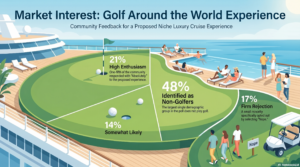
The concept, discussed in connection with Odyssey and Avora Lumina, would potentially allow golf enthusiasts to combine global travel with access to some of the world’s most iconic golf destinations.
That idea now appears to be moving beyond a simple community discussion.
Avora Lumina has announced a “Golf Around the World” program, described as a once-in-a-lifetime opportunity to travel the world while playing at some of the best golf clubs near the coast. The announcement fits naturally with Avora Lumina’s broader residential cruise model, which is built around long-duration global living, extended port stays, and a three-year continuous circumnavigation visiting more than 140 countries and over 400 destinations.
I am not a golf enthusiast, but I can imagine that for those who are, that kind of itinerary creates something traditional golf travel cannot easily match: the ability to experience the sport as part of a continuous global lifestyle rather than as a series of disconnected vacations.
The response from the Live at Sea community was revealing.
Twenty-one percent of respondents said they would “absolutely” participate, while another 14% said they were somewhat likely to join.
Interestingly, the largest category, 48%, selected “Not a Golfer.”
At first, that result might seem negative for the concept. But the results actually reveal something far more useful.
Even within a community where nearly half of respondents don’t play golf, more than one-third still expressed direct interest in the program.
That’s significant.
Golf is not a universal activity. Unlike dining or entertainment, it naturally appeals to a more specific audience. Yet the poll suggests there may still be enough demand to support specialized onboard experiences centered around shared interests.
That matters because residential cruise communities operate very differently from traditional cruise vacations.
Long-term residents don’t just want transportation and sightseeing. They want community.
Shared activities become essential in building friendships, routines, and social identity onboard.
Golf offers several advantages in that environment.
It’s social, structured, travel-friendly, and deeply tied to destination experiences. A golf-focused program could create opportunities for residents to connect both onboard and during excursions in ports around the world.
Imagine residents spending several days exploring Scotland’s historic courses, golfing along the coastlines of New Zealand, visiting famous destinations in Spain or Japan, or playing near iconic American golf destinations such as Pebble Beach.
The appeal goes well beyond the game itself.
Golf communities often create strong social bonds. Regular tee times, tournaments, lessons, travel groups, and shared experiences naturally encourage relationship-building among residents.
That kind of social cohesion becomes increasingly important in long-term cruise living.
Unlike short cruises where passengers rotate weekly, residential cruise ships rely on sustained community engagement. Activities that repeatedly bring residents together may ultimately shape onboard culture as much as dining or entertainment.
The Avora Lumina announcement also shows how residential cruising may evolve from simple travel logistics into curated lifestyle programming.
A ship that spends more time in port can offer residents deeper access to destinations. For golfers, that could mean more than a quick shore excursion. It could mean organized play, multi-day golf outings, instruction, resident tournaments, and destination-based golf communities that follow the ship around the world.
That is a very different model from traditional cruising.
It turns the ship into a platform for shared passions.
The poll also highlights another important reality:
Residential cruising may thrive by offering niche experiences rather than trying to appeal equally to everyone all the time.
Not every resident needs to golf.
In fact, the strongest communities often emerge when multiple interest groups coexist onboard:
- Golf enthusiasts
- Wellness-focused residents
- Food and wine communities
- Adventure travelers
- Cultural excursion groups
- Fitness and outdoor clubs
- Creative and educational communities
Personally, I would be more likely to sign up for a global wine tour, and that may be the better comparison. Imagine residents visiting Napa Valley during a San Francisco stop, exploring Chile’s Casablanca Valley near Valparaíso, or tasting their way through Australia’s Barossa Valley near Adelaide.
Each of those experiences would turn a port visit into something more meaningful than a quick tour bus stop. Residents could build shared memories around wine regions, local food, day trips, tastings, and repeated experiences with the same group of people.
And that is exactly the point.
The future of residential cruising may not be built around one dominant activity. It may be built around many overlapping lifestyle communities. Some residents will organize around golf. Others may gather around wine, wellness, cooking, hiking, art, history, fitness, or entrepreneurship.
That diversity creates layers of social life onboard rather than a one-size-fits-all community.
The fact that nearly half the respondents selected “Not a Golfer” does not really hurt the concept. It simply reflects the reality that residential cruise living will likely consist of many micro-communities operating side-by-side.
And that may be the ideal outcome.
Successful residential ships won’t just function as floating condos. They’ll function as living ecosystems where people can pursue different passions while still sharing a broader community identity.
Golf may never become the defining feature of life at sea.
But the Avora Lumina announcement, combined with the Live at Sea community poll, suggests something bigger:
Residents are actively imagining how specialized interests and shared passions could shape the future culture of residential cruising.
And that’s exactly how real communities begin to form.

