World Cruise vs. Residential Cruise Ship: What’s the Real Difference?
I will be honest. I wasn’t entirely sure there was one when I first asked the question of our Live at Sea Facebook Group.
A world cruise can run three to five months. That’s not a vacation. That’s a season of your life lived at sea. So when I started wondering how a world cruise really compares to living on a residential ship, I figured the best people to ask were the ones who had actually done both.
I put the question to members of the Live at Sea Facebook group. The responses surprised me.
More Similar Than You’d Think
Before getting into the differences, it’s worth acknowledging the overlap.
Whether you’re on a five-month world cruise or a long-term residential ship, you’re dealing with the same realities. You’re away from family. You may have left pets behind, or in some cases brought them along. You’re figuring out how to stay connected to work, health care, and the life you had on land. The ship becomes your world, your dining room, your social life, your bedroom.
Those challenges don’t disappear based on what type of ship you’re on.
But the Ships Are Set Up Very Differently
That’s where the comparison starts to break down.
A world cruise is a commercial cruise experience, just a longer one. Lines like Silversea, Seabourn, Regent Seven Seas, and Explora Journeys design these voyages to be exceptional. And they are. You have a plethora of entertainment, live shows, casinos, formal nights, specialty dining, and a packed daily schedule. Ports come frequently, sometimes every day, and the efficiency of moving through destinations is part of the appeal. You are, in every sense of the word, on vacation.
A residential ship is something else entirely.
One member of the Live at Sea group who had completed three world cruises before boarding Villa Vie Residences Odyssey put it simply. A residential cruise doesn’t have an end date.
No shows. No captain’s parties. No dress codes. The ship is home and it’s structured that way.
What the Community Said
I asked Live at Sea members what they saw as the real advantages of each. Here’s what came back.
On world cruises, several members pointed to the experience itself. The luxury, the entertainment, the ports, the food. You’re living life to the fullest in a contained, curated environment. Everything is taken care of. Everything is designed to delight you. For people who want an extraordinary travel experience without restructuring their entire life, a world cruise delivers exactly that.
One member also noted the social dynamic. On a world cruise you’re meeting new people each sailing. For some, that’s a feature, not a limitation.
On residential ships, the word that came up most often was community.
John L. Hennessee has been living aboard Villa Vie Odyssey for over fifteen months. He’s one of the more prominent voices in the Live at Sea community and someone who has thought deeply about what separates residential cruising from anything else on the water.
His first point is about pace. “A world cruise is a fast cruise of only 100 to 200 days,” he says. “Odyssey takes three and a half years to circumnavigate the world. You only spend a few hours in each port on a world cruise. Odyssey usually spends at least one overnight in the vast majority of ports, and as much as five nights in some destinations, like Rio for Carnival. You really get to explore and see the places you visit.”
He’s equally direct about flexibility. “On the Odyssey you can come and go as you please. You can even rent your villa for a period of time when you leave to visit home, take care of medical issues, or for whatever reason.”
But it’s community where Hennessee gets most personal. “The greatest experience on the Odyssey is the sense of community,” he says. “This became exceptionally apparent when one of our residents passed from a sudden heart attack. The way the community came together to honor his passing and celebrate his life was absolutely astounding. All residents support each other and help them through whatever difficulties are encountered.”
He’s also seen it change people. “We have seen many residents who boarded the ship and subsequently experienced life changing fulfillment and happiness living life on the Odyssey. We are living the dream life.” He’s quick to add that it isn’t for everyone. “There are also many that eventually decide this isn’t the life for them, or they have too many anchors in their life that hold them back. So they continue with their life on land.”
The crew relationship is different too. On Odyssey, crew members are considered part of the community, joining sailaways, sharing moments, visible in ways that feel personal rather than transactional.
The Food Is Different Too
This one doesn’t get talked about enough.
On a world cruise you eat like you’re on vacation, because you are. Indulgent meals, specialty restaurants, everything available all the time. It’s part of the experience and it’s wonderful.
On a residential ship you eat like you live somewhere. Members cook occasionally, develop routines, and don’t necessarily want a five-course dinner every night. The relationship with food shifts from celebratory to simpler daily healthier cuisine. That’s not a downgrade. It’s just home.
What Does It Actually Cost?
This is where the two models really start to diverge.
A world cruise can range widely depending on the cruise line and the level of luxury. On mainstream cruise lines, four-month world cruises often start around $15,000 to $30,000 per person. But once you move into the luxury segment, the numbers climb quickly.
Luxury world cruises with lines like Silversea, Seabourn, and Regent Seven Seas commonly start around $80,000 to $100,000 per person, with premium suites climbing well past $300,000 for the full voyage. At the very top end, some of the most exclusive suites on ultra-luxury world cruises have sold for more than $800,000 per person.
When you break it down, many luxury world cruises fall somewhere between $300 and $800 per person per day, depending on the ship and what is included.
The key thing is that a world cruise is a one-time experience. You pay for the voyage, sail for several months, and when it ends, you return to life on land.
Residential cruise ships work very differently.
Instead of paying for a single voyage, you typically purchase or lease a residence on the ship.
On Villa Vie Odyssey, full ownership of an interior villa starts at about $129,999, with monthly service fees beginning around $1,999 per month for double occupancy. Balcony villas start around $329,000, with higher monthly fees depending on the category.
Villa Vie also offers several lower-commitment ways to live aboard. A five-year ownership option starts around $49,999, and month-to-month living aboard the ship begins at roughly $2,999 per person per month.
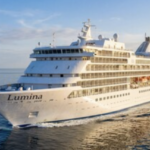
At the luxury end of the residential market, Avora Lumina, scheduled to launch in 2028, is positioning itself closer to high-end real estate than traditional cruising.
Residences on Lumina are expected to start around $545,000 and reach approximately $4.2 million for the largest homes on board. The ship will also offer a five-year ownership option starting around $219,600, giving residents a way to experience long-term life at sea without purchasing a full lifetime residence.
That structure changes the math completely.
Instead of comparing one cruise fare to another, you are comparing the cost of living on land to the cost of living at sea. For some people, especially retirees or remote workers, the numbers can end up surprisingly comparable once housing, travel, utilities, and daily expenses are factored in.
But the bigger difference is not just financial.
A world cruise is something you book.
A residential ship is somewhere you move.
Your Options Today
The residential cruise space is still small but growing. The World sits at the ultra-luxury end of the market. Villa Vie Odyssey offers a more accessible entry point. Avora Lumina is one of the more exciting newcomers, a newly converted residential ship formerly known as Regent Seven Seas Navigator, owned by NCL, and set to launch in January 2028. Several other residential ship concepts are in development and, hopefully, many more are coming.
The world cruise market, by contrast, is well established and expanding, with more luxury lines adding extended voyages every year.
My Takeaway
A world cruise is one of the greatest travel experiences you can have. The entertainment, the ports, the food, the people. You are absolutely living life to the fullest. But at the end of it, you go home.
On a residential cruise ship, you are already home.
That’s the real difference. A world cruise is a vacation, an extraordinary one. A residential cruise ship is a lifestyle. It’s not for everyone, but for the people who choose it, it tends to change everything.
The category even deserves its own name. Not a cruise ship. A lifestyle cruise ship.
This article was inspired by a discussion in the Live at Sea Facebook group. If you’re exploring life at sea, it’s one of the best communities on the internet to start.