Should Dogs and Cats and Whatever Live at Sea? The Debate Isn’t Settled

The idea of living at sea is no longer a fantasy. With residential cruise concepts gaining traction, a new question has surfaced:

Can pets come too?

For many, pets are family. The thought of leaving them behind is a dealbreaker. But bringing animals into a floating, internationally regulated environment turns out to be far more complex than it first appears.

The Vision: A Pet-Friendly Life at Sea

In theory, a pet-friendly cruise lifestyle sounds entirely possible.

Ships could be designed with dedicated pet areas, relief stations, onboard veterinary services, and even pet-specific amenities.

Some early examples already exist. Certain ships have allowed cats onboard, suggesting that a pet-inclusive model isn’t just hypothetical.

But that’s where the simplicity ends.

The Reality: It’s Not Just a Cruise Line Decision

One of the biggest misconceptions is that pet policies are controlled solely by the cruise operator.

They’re not.

Even if a ship allows pets, international regulations govern what happens when that ship enters different countries. Residents currently living aboard ships emphasize that pets are subject to strict biosecurity laws, regardless of whether they ever leave the vessel.

Biosecurity: The Real Constraint

Countries like Australia and New Zealand enforce some of the strictest biosecurity regulations in the world.

The concern isn’t just animals entering the country. It includes disease transmission, parasites, environmental contamination, and even how animal waste is handled.

In some cases, inspectors board the ship regularly, pets must be monitored and documented, owners may be required to pay inspection-related fees, and ships may only visit ports with proper animal control infrastructure.

If a port doesn’t meet these requirements, the ship may not be able to dock.

Quarantine Isn’t What You Think

It’s easy to assume pets simply stay in their owner’s cabin when regulations tighten.

In reality, it can be much stricter.

Residents report that in certain regions pets are moved to designated quarantine cabins, often on lower decks. Animals may be kept in enclosures for inspection, inspections can occur daily or even multiple times per day, and owner access can be restricted or scheduled.

This creates a very different experience from normal onboard living.

Itineraries Can Change Because of Pets

Allowing pets doesn’t just affect individual owners. It can impact the entire ship.

Ships have had to skip ports lacking biosecurity personnel and adjust itineraries based on regulatory requirements. While some residents consider this a minor inconvenience, others see it as a meaningful trade-off in destination flexibility.

It’s Not Just Pets Under Scrutiny

Interestingly, pets are only part of the biosecurity equation.

Items that leave the ship such as bicycles, golf clubs, wheelchairs, walkers, and even hiking boots can sometimes face equal or greater scrutiny since they interact directly with land environments.

This highlights how complex and far-reaching these regulations really are.

What Life Is Actually Like for Pets Onboard

On ships that currently allow animals, the day-to-day reality is more controlled than many expect.

Pets may be confined to cabins full-time, limited designated outdoor areas may exist, and many residents may never encounter the animals onboard unless they seek them out.

For some pets, especially older or indoor animals, this environment can work well. For others, it may not be ideal.

The Biggest Limitation: Mobility

One of the least discussed challenges is what happens when you want to leave the ship.

In most cases, pets are not allowed ashore. Veterinary care must be brought onboard. Leaving the ship with a pet may require full import procedures, and travel between countries introduces additional layers of regulation.

In practical terms, bringing a pet onboard often means committing to a much more stationary lifestyle than expected.

So Can Pets Live at Sea

The answer is not a simple yes or no.

A pet-friendly cruise lifestyle is clearly possible, and early examples prove it can be done.

But it comes with regulatory complexity, operational constraints, and lifestyle trade-offs.

As members of the residential cruise community have pointed out, it is achievable, but only with compromises and caveats.

Final Thought

The dream of living at sea with your pet isn’t unrealistic.

It’s just not as carefree as people imagine.

And once you bring international law, environmental protection, and a moving city into the equation, things get complicated fast.

World Cruise vs. Residential Cruise Ship: What’s the Real Difference?

I will be honest. I wasn’t entirely sure there was one when I first asked the question of our Live at Sea Facebook Group.

A world cruise can run three to five months. That’s not a vacation. That’s a season of your life lived at sea. So when I started wondering how a world cruise really compares to living on a residential ship, I figured the best people to ask were the ones who had actually done both.

I put the question to members of the Live at Sea Facebook group. The responses surprised me.

More Similar Than You’d Think

Before getting into the differences, it’s worth acknowledging the overlap.

Whether you’re on a five-month world cruise or a long-term residential ship, you’re dealing with the same realities. You’re away from family. You may have left pets behind, or in some cases brought them along. You’re figuring out how to stay connected to work, health care, and the life you had on land. The ship becomes your world, your dining room, your social life, your bedroom.

Those challenges don’t disappear based on what type of ship you’re on.

But the Ships Are Set Up Very Differently

That’s where the comparison starts to break down.

A world cruise is a commercial cruise experience, just a longer one. Lines like Silversea, Seabourn, Regent Seven Seas, and Explora Journeys design these voyages to be exceptional. And they are. You have a plethora of entertainment, live shows, casinos, formal nights, specialty dining, and a packed daily schedule. Ports come frequently, sometimes every day, and the efficiency of moving through destinations is part of the appeal. You are, in every sense of the word, on vacation.

A residential ship is something else entirely.

One member of the Live at Sea group who had completed three world cruises before boarding Villa Vie Residences Odyssey put it simply. A residential cruise doesn’t have an end date.

No shows. No captain’s parties. No dress codes. The ship is home and it’s structured that way.

What the Community Said

I asked Live at Sea members what they saw as the real advantages of each. Here’s what came back.

On world cruises, several members pointed to the experience itself. The luxury, the entertainment, the ports, the food. You’re living life to the fullest in a contained, curated environment. Everything is taken care of. Everything is designed to delight you. For people who want an extraordinary travel experience without restructuring their entire life, a world cruise delivers exactly that.

One member also noted the social dynamic. On a world cruise you’re meeting new people each sailing. For some, that’s a feature, not a limitation.

On residential ships, the word that came up most often was community.

John L. Hennessee has been living aboard Villa Vie Odyssey for over fifteen months. He’s one of the more prominent voices in the Live at Sea community and someone who has thought deeply about what separates residential cruising from anything else on the water.

His first point is about pace. “A world cruise is a fast cruise of only 100 to 200 days,” he says. “Odyssey takes three and a half years to circumnavigate the world. You only spend a few hours in each port on a world cruise. Odyssey usually spends at least one overnight in the vast majority of ports, and as much as five nights in some destinations, like Rio for Carnival. You really get to explore and see the places you visit.”

He’s equally direct about flexibility. “On the Odyssey you can come and go as you please. You can even rent your villa for a period of time when you leave to visit home, take care of medical issues, or for whatever reason.”

But it’s community where Hennessee gets most personal. “The greatest experience on the Odyssey is the sense of community,” he says. “This became exceptionally apparent when one of our residents passed from a sudden heart attack. The way the community came together to honor his passing and celebrate his life was absolutely astounding. All residents support each other and help them through whatever difficulties are encountered.”

He’s also seen it change people. “We have seen many residents who boarded the ship and subsequently experienced life changing fulfillment and happiness living life on the Odyssey. We are living the dream life.” He’s quick to add that it isn’t for everyone. “There are also many that eventually decide this isn’t the life for them, or they have too many anchors in their life that hold them back. So they continue with their life on land.”

The crew relationship is different too. On Odyssey, crew members are considered part of the community, joining sailaways, sharing moments, visible in ways that feel personal rather than transactional.

The Food Is Different Too

This one doesn’t get talked about enough.

On a world cruise you eat like you’re on vacation, because you are. Indulgent meals, specialty restaurants, everything available all the time. It’s part of the experience and it’s wonderful.

On a residential ship you eat like you live somewhere. Members cook occasionally, develop routines, and don’t necessarily want a five-course dinner every night. The relationship with food shifts from celebratory to simpler daily healthier cuisine.   That’s not a downgrade. It’s just home.

What Does It Actually Cost?

This is where the two models really start to diverge.

A world cruise can range widely depending on the cruise line and the level of luxury. On mainstream cruise lines, four-month world cruises often start around $15,000 to $30,000 per person. But once you move into the luxury segment, the numbers climb quickly.

Luxury world cruises with lines like Silversea, Seabourn, and Regent Seven Seas commonly start around $80,000 to $100,000 per person, with premium suites climbing well past $300,000 for the full voyage. At the very top end, some of the most exclusive suites on ultra-luxury world cruises have sold for more than $800,000 per person.

When you break it down, many luxury world cruises fall somewhere between $300 and $800 per person per day, depending on the ship and what is included.

The key thing is that a world cruise is a one-time experience. You pay for the voyage, sail for several months, and when it ends, you return to life on land.

Residential cruise ships work very differently.

Instead of paying for a single voyage, you typically purchase or lease a residence on the ship.

On Villa Vie Odyssey, full ownership of an interior villa starts at about $129,999, with monthly service fees beginning around $1,999 per month for double occupancy. Balcony villas start around $329,000, with higher monthly fees depending on the category.

Villa Vie also offers several lower-commitment ways to live aboard. A five-year ownership option starts around $49,999, and month-to-month living aboard the ship begins at roughly $2,999 per person per month.

At the luxury end of the residential market, Avora Lumina, scheduled to launch in 2028, is positioning itself closer to high-end real estate than traditional cruising.

Residences on Lumina are expected to start around $545,000 and reach approximately $4.2 million for the largest homes on board. The ship will also offer a five-year ownership option starting around $219,600, giving residents a way to experience long-term life at sea without purchasing a full lifetime residence.

That structure changes the math completely.

Instead of comparing one cruise fare to another, you are comparing the cost of living on land to the cost of living at sea. For some people, especially retirees or remote workers, the numbers can end up surprisingly comparable once housing, travel, utilities, and daily expenses are factored in.

But the bigger difference is not just financial.

A world cruise is something you book.

A residential ship is somewhere you move.

Your Options Today

The residential cruise space is still small but growing. The World sits at the ultra-luxury end of the market. Villa Vie Odyssey offers a more accessible entry point. Avora Lumina is one of the more exciting newcomers, a newly converted residential ship formerly known as Regent Seven Seas Navigator, owned by NCL, and set to launch in January 2028. Several other residential ship concepts are in development and, hopefully, many more are coming.

The world cruise market, by contrast, is well established and expanding, with more luxury lines adding extended voyages every year.

My Takeaway

A world cruise is one of the greatest travel experiences you can have. The entertainment, the ports, the food, the people. You are absolutely living life to the fullest. But at the end of it, you go home.

On a residential cruise ship, you are already home.

That’s the real difference. A world cruise is a vacation, an extraordinary one. A residential cruise ship is a lifestyle. It’s not for everyone, but for the people who choose it, it tends to change everything.

The category even deserves its own name. Not a cruise ship. A lifestyle cruise ship.

This article was inspired by a discussion in the Live at Sea Facebook group. If you’re exploring life at sea, it’s one of the best communities on the internet to start.

Avora Lumina Is Selling Fast: Inside the Residential Cruise Ship That Is Turning Heads

As first reported on Startup.club and the Live at Sea Facebook Group, Avora Residences launched in February of 2026. Since then it is making serious waves in the world of residential cruising. And based on what I am hearing directly from the company, the market is responding.

I spoke personally with President Chris Cox just a few days ago. His message was straightforward. They are being overwhelmed with demand. In the weeks since the announcement, dozens of units have been sold or reserved. What is particularly interesting is that it is not just one segment of buyers driving that activity. The lower cost entry-level units are going fast. But the larger, higher-priced residences are also being snapped up quickly. Demand is coming from both ends of the market.

As one example, Avora has already sold or reserved approximately 40 percent of its Solstice Class units. For a ship that does not launch until January 2028, those numbers speak for themselves.

That kind of early momentum is hard to ignore.

What Is Avora Lumina?

Avora Lumina is a new residential cruise ship launching in January 2028. It is being converted from Regent Seven Seas Navigator, an ultra-luxury vessel owned by NCL. The project is led by Residential Cruise Holdings, the same company that operates Villa Vie Odyssey, giving it real operational experience in long-term life at sea.

This is not a concept. This is not a render on a website. The deal with NCL has been signed. The ship exists. The launch date is set.

That distinction matters more than it might seem.

A Ship I Have Sailed Before

I traveled on a Regent Seven Seas ship in 2023 and came away genuinely impressed. What stood out was not the size or the amenities — it was the feel of the ship. Fewer people. Staff who actually knew your name by day two. A level of personalized service that is hard to find on larger vessels. It felt less like a cruise and more like a private club that happened to be floating.

The new owners have no intention of walking away from what made the Navigator great.

The arrangement with Norwegian Cruise Line includes a nine-year charter with a nominal purchase option, establishing a long-term operational relationship with one of the most experienced maritime organizations in the world. Avora has committed to preserving the operational DNA of the Navigator wherever possible, which I think is a key winning move:  maintaining established systems, standards, and key vendor and service relationships that have defined the vessel’s performance over decades of global service. Having sailed the smaller Regent class ships, I can say it is probably one of the best floating experiences in the world. 

Regent Seven Seas is widely considered one of the top ultra-luxury cruise lines on the planet, combining exceptional gourmet dining, spacious all-suite accommodations, and staff-to-guest ratios that create a genuine five-star hotel experience at sea. Nearly everything is included: fine dining, premium wines, excursions, gratuities. The experience never feels nickel-and-dimed. The fact that Avora intends to preserve that operational culture rather than replace it is one of the most compelling things about this conversion. It truly will be an ultra luxury residence at sea.

As Kathy Villalba put it, “Navigator has a soul, built through years of disciplined operations, experienced crews, and trusted relationships. We intend to honor that legacy while transforming the ship into a true long-term residential platform.”

In my opinion, that is exactly the right approach.

Why This One Is Different

Getting in early on a cruise condo project has historically carried real risk. Several high-profile residential ship concepts have raised money, generated excitement, and then quietly disappeared before a single passenger ever boarded. Buyers have been burned.

Avora Lumina is different for a few reasons.

First, the ship is already in hand. Securing the rights to Regent Seven Seas Navigator through a deal with NCL removes one of the biggest uncertainties that has sunk other projects. There is no waiting for a shipyard to deliver a vessel that may or may not materialize.

Second, the operator has done this before. The operators also run Villa Vie Odyssey, which means the team understands what long-term residential living at sea actually requires. This is not a group of hotel developers guessing at how to run a ship. And to be clear they had their challenges and continue to work through them. And from my conversations with them have learned from those mistakes: what works and what doesn’t work. Converting a legacy cruise ship to residential condo doesn’t exactly have a playbook. 

Third, the legacy of the Navigator itself adds credibility. The bones of this ship are exceptional. Every unit is a relatively large suite based on traditional cruise ship standards, with residences ranging from approximately 300 to over 1,100 square feet. The ship underwent a $40 million refurbishment in 2016 and already has an apartment-like feel, with larger suites, laundry facilities, and a more intimate scale than the massive ships dominating cruising today. It is the kind of vessel that lends itself naturally to long-term living.

How the Ship Is Being Transformed

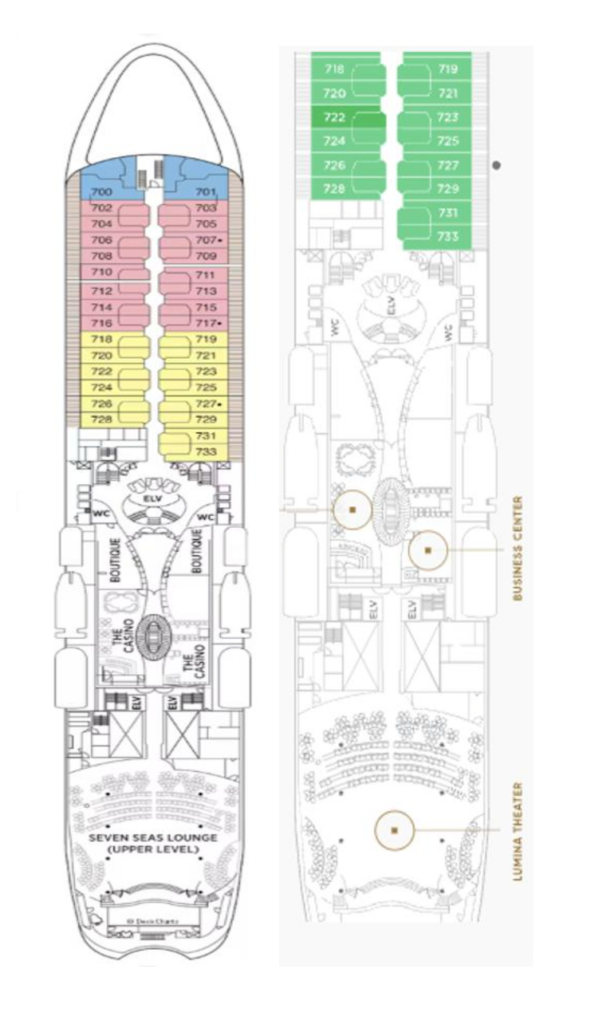
The deck plans tell the story better than any press release.

A Live at Sea employee shared side-by-side comparisons of the original Regent Seven Seas Navigator layout alongside the planned Avora Lumina conversion. The differences are deliberate and revealing.

Deck 7: Casino becomes a Business Center. On the Navigator, Deck 7 housed a full casino and boutiques — classic cruise ship amenities built for vacationers. On Avora Lumina, that space is being converted into a dedicated Business Center. This is one of the clearest signals of who this ship is being built for. Residents who work remotely or run businesses need productive space, not slot machines.

Deck 6: Entertainment becomes community spaces. The Navigator’s Deck 6 featured the Seven Seas Lounge, a Stars Lounge, and a Coffee Connection area branded around Club.com. 

Avora Lumina replaces this with the Lumina Lounge, a Library, a Solace Lounge, and a Card and Conference Room. The shift is from transient entertainment to spaces designed for longer-term living and gathering.

Deck 5: Compass Rose dining becomes Meridian House. The Navigator’s signature main dining room, Compass Rose, gave way to Meridian House on Avora Lumina. 

The footprint is similar but the name and concept shift signals a more residential dining philosophy rather than a formal cruise restaurant experience.

Deck 10: Pool deck gets refined. The Navigator’s pool deck featured La Veranda and Prime 7, well-known Regent dining venues. Avora Lumina introduces Ember and Oak and Serene at the Terrace, along with a Pool Grill and Pool Bar. The overall outdoor living space remains generous and social.

Deck 11: Jogging track and Aurelia Lounge replace Galileo’s Lounge. The Navigator’s observation lounge at the top of the ship becomes a more active space on Lumina, with a jogging track surrounding an open deck area and the Aurelia Lounge replacing Galileo’s as the social anchor on the upper deck.

Wellness deck: Lumina Spa replaces the original spa. The fitness center, aerobics studio, saunas, and beauty salon footprint stays largely intact. The rebrand to Lumina Spa reflects the overall identity shift, and the space appears to be refined rather than dramatically altered. For long-term residents, a well-equipped wellness facility matters far more than it does for a two-week cruise passenger.

Living on a ship is very different from vacationing on one. Residents don’t need constant entertainment, bars, or casinos. Instead, health and wellness replace the midnight buffet, and peace and quiet replace the bingo announcements and belly-flop contests.

Three Years Around the World

One detail from their press announcement that I think deserves more attention is the itinerary structure.

Avora Lumina plans to launch from Lisbon, Portugal and embark on a three-year continuous global circumnavigation, visiting more than 140 countries and over 400 destinations across all seven continents. The ship will spend up to five days in port at a time, prioritizing depth of experience over rapid port turnover.

But here is what really sets this apart. After the first circumnavigation, residents will have structured input into future itineraries. Chris Cox described it directly: “We are building a resident-driven global platform. After the first circumnavigation, owners will help shape where Lumina sails next. That fundamentally changes the residential cruise model.”

The ship is also polar-certified, enabling voyages to Antarctica and the Northeast Passage, destinations that most residential ships cannot access. And remember, it’s a smaller ship, allowing it to access far more ports than the giant cruise ships of today.

The company also announced “Golf around the world program” offering a once in a lifetime experience travelling around the world and playing at some of the best golf clubs in the world near the coast.  

Elevating the Culinary Experience

Avora is also making a serious commitment to food, which matters more than people give it credit for when you are living somewhere full time.

The culinary program will feature destination-inspired dining concepts that reflect the regions visited throughout the circumnavigation. Rotating seasonal menus, elevated wine programs, chef-led tastings, and locally sourced ingredients made possible through extended port stays will define the onboard dining experience.

This is not cruise ship food. This is a program built around the idea that what is on your plate should reflect where you are in the world.

Who Is It Built For?

Avora Lumina is designed for people who want to live, work, and travel the world from a single address that happens to move.

The conversion plan includes dedicated workspaces, with the casino being repurposed into productive work areas. High speed satellite internet powered by Starlink is expected onboard. I used Starlink on a recent cruise to Iceland and was able to make calls, join a podcast, and watch Netflix in the evening. The only challenge was finding a quiet place to work. That problem appears to be one Avora has thought about.

For remote workers, entrepreneurs, retirees, and founders, this is a genuinely compelling proposition. Launching a startup at sea is no longer a hypothetical.

What Does It Cost?

Avora has introduced pricing that is competitive for the ultra-luxury residential segment. Residences are expected to start around $545,000 and reach approximately $4.2 million for the largest homes onboard. A five-year ownership option is available starting around $219,600, priced at roughly 40 percent of a unit’s full value. 

Monthly fees for the smallest suites start at approximately $8,355 for single occupancy and $12,355 for double, covering an all-inclusive lifestyle that includes dining, housekeeping, concierge services, and continuous global travel.

Owners who are not onboard full time will also have the option to rent out their residences, which creates the possibility of offsetting ownership costs or generating a return. 

The Bigger Picture

Residential cruising is still a small market but it is growing. In 2025, the cruise industry carried approximately 37.7 million passengers worldwide. An estimated 30,000 to 40,000 of those took world cruises. The residential segment sits at a fraction of that number today, but projects like Avora Lumina are bringing it closer to the mainstream.

The founder of Avora Residences, Mikael Petterson, put it simply. “Residential cruising has proven its viability. Avora Lumina represents the next evolution, purpose-built for long-duration global living, expedition capability, and a more refined residential experience.”

Based on the demand Chris Cox described, the market appears to agree.

If you want to follow the story as it develops, join the Live at Sea Facebook Group or come back for more in depth articles about living at sea on LiveAtSea.com.

Live At Sea: Is This the Start of a
Whole New Way to Live?

Why We Launched the Live at Sea Community and Why More People are Starting to Consider Life on the Ocean.

Have you ever stopped and thought there must be more to life than grinding day after day in a career? Working untold hours and with the reward of spending a few hours at the park if the weather is just right on the weekend. 

That there must be a better way to live?

Don’t get me wrong. I love what I do and I’ll probably never stop working. But I believe there should be a balance between work, play, and life. One can still change the world and live a more balanced life.

I’ve spent a large part of my life traveling the world, one flight after another. At one point my executive team and I even managed to visit three countries in a single day. I’ve sat in boardrooms across the globe, stayed in countless hotel rooms, and spent more hours than I can count in airplane seats.

I went to China thirteen times but never saw the Great Wall. I traveled throughout Europe, but most of my memories are of train rides from one office to another or from one convention to the next. My idea of sightseeing was opening the curtains in the morning to see the view outside the hotel window.

I never had time to truly enjoy the places I visited. All I wanted was to get back home to my family.

Truth be told, I hate traveling.

I love being home.

And that’s exactly why I’ve been fascinated with the idea of living at sea for the past fifteen years.

At first, I tried to satisfy the urge by booking cruises. It started with a weekend cruise, then a week, then eventually a month. But inevitably the Larry David in me would come out and I’d start nit-picking everything I didn’t like about cruising. The crowds. The food. The noise.

So we tried ultra-luxury cruising and discovered that there is a more civilized way to experience life at sea. Unfortunately, like many things in this world, the price made it difficult to do regularly. And near the end of every cruise, my wife and I would feel a little depressed knowing it was almost over and we would not be back for another year.

That’s when the idea for the Live at Sea Facebook group was born.

The community that formed there has shared an incredible amount of information, insight, and personal stories about what it’s really like to live at sea. Topic after topic, I’ve been amazed by the firsthand experiences and practical knowledge people bring to the conversation.

It quickly became clear that the world needed a place to gather, organize, and share this information in one destination. That’s why the live at sea site exists.

More than 30 million people cruise every year, and the number continues to grow rapidly. Cruising has exploded in popularity over the last two decades. Yet only a very small number of people have taken the next step and chosen to actually live at sea.

For years this lifestyle was limited to a tiny group of wealthy residents aboard ships like The World, which launched in 2003.

But that may be starting to change.

The launch of Villa Vie Odyssey has introduced a residential cruise ship designed for people who want to try living at sea on a more sustainable budget. Even more developments are coming, including Avora Lumina, scheduled to launch in January 2028.

This is still a very small community by any standard, but it’s one that is growing quickly.

Innovation, entrepreneurship, lifestyle changes, and new technology are all contributing to the rise of what could become an entirely new way of living. One of the biggest turning points came in the early 2020s with the arrival of Starlink, which made high-speed internet available almost anywhere on the planet. For the first time, people can realistically work remotely, communicate with their family, and yes binge on Netflix from the middle of the ocean.

At LiveAtSea.com we intend to write about real stories by real people. The good and the bad. We will focus on facts and have rigorous editorial standards. It will be a destination for understanding all the nuances of the lifestyle from health care to Amazon shipments. 

What I’m most excited about is teaming up with the Live at Sea community to curate tips and tricks for navigating port cities — from shore excursions to the everyday essentials of living at sea.

For thousands of years humans have lived almost exclusively on land. But technology and pioneers are changing that. 

I believe that sometime in this century we could see one million people living at sea. I know this is a bold prediction. For many it may become a second home, but for others it will be a full-time lifestyle built around living, working, and exploring the world from the ocean.

My wife and I are excited to be part of this journey and one day call the ocean home. Feel free to say when you see us on the residential ship. In the meantime, join us on the journey together as pioneers of a new way of living by joining us on the Live at Sea Facebook Group.

Sample port hack 1

Review of ship name test