
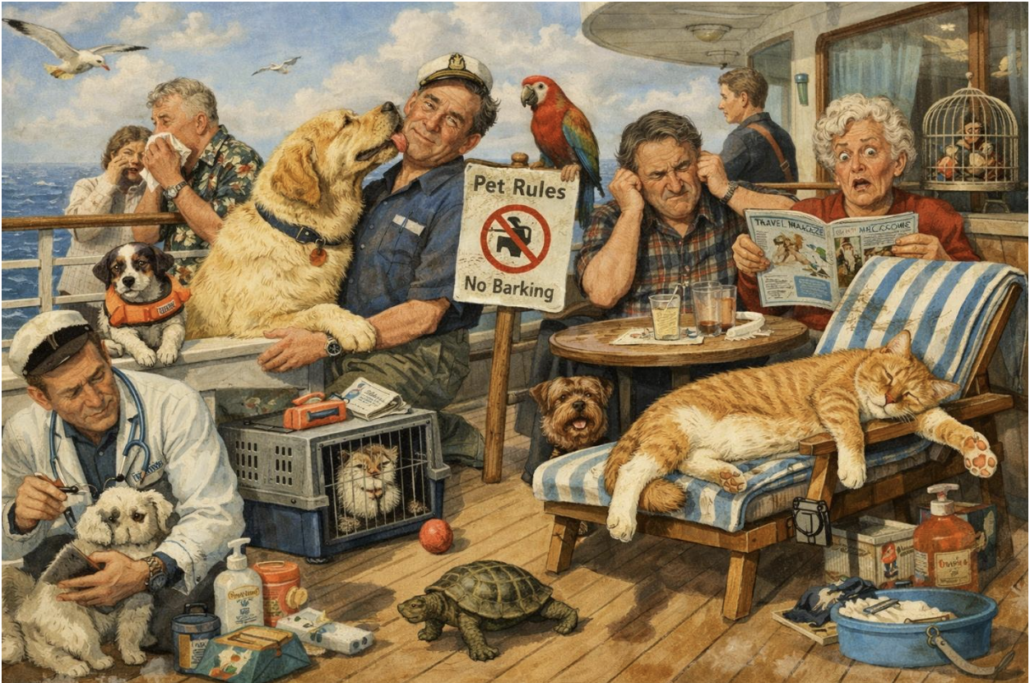

Should Dogs and Cats and Whatever Live at Sea? The Debate Isn’t Settled
The idea of living at sea is no longer a fantasy. With residential cruise concepts gaining traction, a new question has surfaced:
Can pets come too?
For many, pets are family. The thought of leaving them behind is a dealbreaker. But bringing animals into a floating, internationally regulated environment turns out to be far more complex than it first appears.
The Vision: A Pet-Friendly Life at Sea
In theory, a pet-friendly cruise lifestyle sounds entirely possible.
Ships could be designed with dedicated pet areas, relief stations, onboard veterinary services, and even pet-specific amenities.
Some early examples already exist. Certain ships have allowed cats onboard, suggesting that a pet-inclusive model isn’t just hypothetical.
But that’s where the simplicity ends.
The Reality: It’s Not Just a Cruise Line Decision
One of the biggest misconceptions is that pet policies are controlled solely by the cruise operator.
They’re not.
Even if a ship allows pets, international regulations govern what happens when that ship enters different countries. Residents currently living aboard ships emphasize that pets are subject to strict biosecurity laws, regardless of whether they ever leave the vessel.
Biosecurity: The Real Constraint
Countries like Australia and New Zealand enforce some of the strictest biosecurity regulations in the world.
The concern isn’t just animals entering the country. It includes disease transmission, parasites, environmental contamination, and even how animal waste is handled.
In some cases, inspectors board the ship regularly, pets must be monitored and documented, owners may be required to pay inspection-related fees, and ships may only visit ports with proper animal control infrastructure.
If a port doesn’t meet these requirements, the ship may not be able to dock.
Quarantine Isn’t What You Think
It’s easy to assume pets simply stay in their owner’s cabin when regulations tighten.
In reality, it can be much stricter.
Residents report that in certain regions pets are moved to designated quarantine cabins, often on lower decks. Animals may be kept in enclosures for inspection, inspections can occur daily or even multiple times per day, and owner access can be restricted or scheduled.
This creates a very different experience from normal onboard living.
Itineraries Can Change Because of Pets
Allowing pets doesn’t just affect individual owners. It can impact the entire ship.
Ships have had to skip ports lacking biosecurity personnel and adjust itineraries based on regulatory requirements. While some residents consider this a minor inconvenience, others see it as a meaningful trade-off in destination flexibility.
It’s Not Just Pets Under Scrutiny
Interestingly, pets are only part of the biosecurity equation.
Items that leave the ship such as bicycles, golf clubs, wheelchairs, walkers, and even hiking boots can sometimes face equal or greater scrutiny since they interact directly with land environments.
This highlights how complex and far-reaching these regulations really are.
What Life Is Actually Like for Pets Onboard
On ships that currently allow animals, the day-to-day reality is more controlled than many expect.
Pets may be confined to cabins full-time, limited designated outdoor areas may exist, and many residents may never encounter the animals onboard unless they seek them out.
For some pets, especially older or indoor animals, this environment can work well. For others, it may not be ideal.
The Biggest Limitation: Mobility
One of the least discussed challenges is what happens when you want to leave the ship.
In most cases, pets are not allowed ashore. Veterinary care must be brought onboard. Leaving the ship with a pet may require full import procedures, and travel between countries introduces additional layers of regulation.
In practical terms, bringing a pet onboard often means committing to a much more stationary lifestyle than expected.
So Can Pets Live at Sea
The answer is not a simple yes or no.
A pet-friendly cruise lifestyle is clearly possible, and early examples prove it can be done.
But it comes with regulatory complexity, operational constraints, and lifestyle trade-offs.
As members of the residential cruise community have pointed out, it is achievable, but only with compromises and caveats.
Final Thought
The dream of living at sea with your pet isn’t unrealistic.
It’s just not as carefree as people imagine.
And once you bring international law, environmental protection, and a moving city into the equation, things get complicated fast.