
Retiring on a Cruise Ship: What It’s Really Like to Live at Sea
Darren Budak came home one day and told his wife, Kris, he had a plan for their retirement.
“We’re going to live on a cruise ship.”
Her response was immediate. “No, we’re not.”
But Darren knew his wife well enough to give her some time to think about it. About ten days later, Kris came back and told him she thought it was a pretty good idea after all. Her only condition was that they would never sell their house.
Six months later, she was asking when they could sell it.
Today, Darren and Kris own a cabin aboard Villa Vie’s Odyssey, and Kris’s parents have bought another cabin just down the hall. Now they’re preparing to move to Avora Lumina, making them part of a very small group of people who have actually lived on one residential cruise ship and decided to move to another.
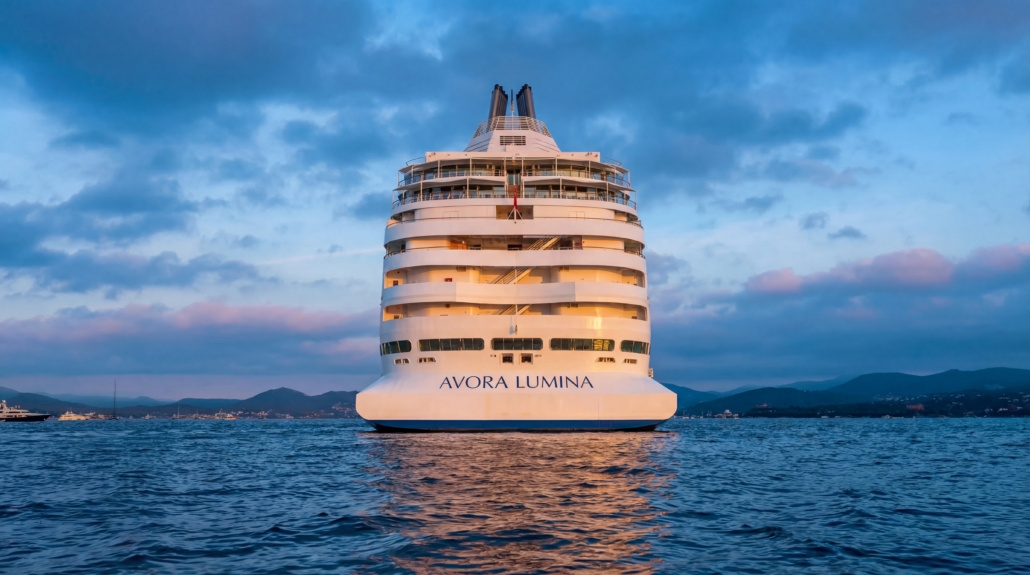
I first met Darren and Kris in Barcelona while touring the Regent Seven Seas Navigator, the ship being converted into Avora Lumina. Kim and I had purchased a residence aboard, and so had they. The difference was that Darren and Kris were already experiencing the lifestyle we were planning to try.
I invited them onto the Live At Sea podcast because I wanted to understand what living on a cruise ship is really like once the excitement of being on vacation wears off. What do you miss? What gets frustrating? How do you deal with seeing the same people every day? And perhaps most importantly, would you do it all over again?
Their answers gave me a much better understanding of what we’re getting ourselves into.
First, Everyone Thinks You’re Crazy
Try telling your family and friends that you’re selling your house and moving onto a cruise ship. Most people don’t even understand what you’re talking about.
“You tell somebody, I bought a cabin on a cruise ship, and they’re like, oh, you own a timeshare,” Darren told me. “No. It’s not a timeshare. I own it. It’s mine. If I’m not in it, nobody’s in it.”
I can relate. When Kim and I tell people we’re planning to live aboard Avora Lumina for part of the year, we get some interesting looks. I think most people picture a traditional seven-day Caribbean cruise with thousands of passengers, crowded pools, buffet lines, and a completely different group of tourists arriving every week.
Residential cruising is a very different experience.
Darren and Kris’s twin sons, Kobe and Christopher, were supportive, and Kobe and his wife have already visited them aboard Odyssey. But the most interesting conversion story involves Kris’s parents.
Her father initially thought Darren had lost his mind. Then he and his wife started spending time aboard Odyssey while Darren and Kris were still working. At one point, they stayed for six months, traveling from Panama and eventually returning to Panama.
They enjoyed the experience so much that they bought their own cabin.
Think about that. The people who initially questioned the whole idea ended up moving in down the hall.
Living on a Cruise Ship Is Not a Permanent Vacation
One of the biggest misconceptions about living at sea is that you’re somehow on vacation every day. Darren was quick to explain that there’s a big difference between taking a cruise and actually making a ship your home.
When you’re on vacation, you feel pressure to do everything. Every port, every excursion, every restaurant, and every show. You’ve paid for the experience, and you want to get your money’s worth. But imagine trying to maintain that pace for five years. You’d be exhausted.
Darren explained that it takes about two or three weeks for your mentality to change. You gradually stop thinking like a tourist and start treating the ship like home.
Some days they wake up, have coffee, enjoy lunch, maybe participate in water aerobics or play cards. Darren has developed a particular fondness for a white bread veggie sandwich and a Coke in the afternoon. Other days, they might spend time relaxing in their cabin without doing much of anything.
“It’s okay to take a day off, sit in your room, do whatever. You don’t have to be a tourist 24/7.”
I loved that comment because one of my concerns about living at sea has been whether I’d feel compelled to do something every day. Apparently, you eventually get over that feeling and settle into a routine, just as you would at home.
They’ve even started decorating their cabin with wallpaper, painting, and window film. These are the same little improvements you might make to a house or condo because you want the space to reflect your personality.
For Darren and Kris, Odyssey isn’t just a cruise ship. It’s their home.
Kris also told me about one of her favorite routines, something she calls “land coffee.” Depending on where the ship is sailing, the coffee aboard can vary, so some mornings they simply walk into town, find a local coffee shop, enjoy a cup, and stroll back to the ship.
It’s such a simple pleasure, but imagine being able to enjoy your morning coffee in a different country every few days.
Sometimes You Just Want to Be Left Alone
Here’s something you probably won’t find in the marketing brochures.
Living aboard a residential cruise ship means being part of a relatively small community where you see many of the same people every day. You’re surrounded by neighbors at breakfast, lunch, dinner, and during activities. That can be a wonderful experience, but it can also become a little overwhelming.
Darren admits he’s not a huge extrovert, and he has a great expression for when he’s had enough socializing.
“My social bucket’s full.”
Fortunately, residents have developed an unwritten social code that helps everyone respect each other’s space. If you sit at a table for two, people generally understand that you’re looking for a quiet dinner together. They’ll wave or say hello but won’t necessarily join you. If you sit at a larger table, you’re signaling that you’re open to company.
And when you really want some time to yourself, you can order room service or spend an evening relaxing in your cabin.
Kris pointed out that there are also plenty of quiet corners around the ship where you can get away without feeling like you’re isolating yourself from the community.
I thought this was one of the more revealing parts of our conversation because a residential cruise ship is essentially a floating neighborhood. You develop friendships, get to know your neighbors, and become part of a community, but you also need the freedom to have some privacy.
Just because you live together doesn’t mean you need to spend every waking hour together.
What Do You Actually Miss When You Live at Sea?
I was particularly interested in what Darren and Kris missed about living on land. I expected them to talk about their house, favorite restaurants, or perhaps having a backyard, but their answers were surprisingly different.
Darren said he misses work.
He’s still employed full-time and hasn’t completely transitioned into retirement, so when he’s aboard, he sometimes feels disconnected from his professional life. I found that interesting because retirement isn’t simply about having enough money to stop working. For many people, work provides purpose, structure, and a sense of accomplishment.
Giving that up can be harder than we expect.
Kris had a completely different answer. She misses watching sports.
Watching a game together is one of the ways they relax, but streaming services and internet connections don’t always cooperate at sea. Add in the time-zone changes, and something as simple as watching college football can mean getting up at four in the morning.
It might sound trivial, but I think these are exactly the kinds of things people need to consider before moving onto a ship.
It’s easy to imagine watching beautiful sunsets over the Mediterranean. It’s harder to imagine missing your favorite football game because the internet isn’t cooperating.
The reality is that you trade some everyday conveniences for a lifestyle that offers experiences you simply couldn’t have if you stayed home.
The Places You Visit Make Up for a Lot
Of course, one of the biggest advantages of living on a cruise ship is waking up in destinations that most people will never have the opportunity to visit.
Darren and Kris shared some incredible stories from their travels.
In Wrangell, Alaska, they took an excursion to Anan Creek, where they watched a grizzly bear swimming after salmon. In Vanuatu, they explored an island on foot and eventually found themselves looking at a beautiful resort with overwater bungalows.
Kris told me she’d always dreamed of staying in one of those huts overlooking the water. But standing on the deck of Odyssey and looking back at the resort, she realized she might already have something better.
“Now I’m like, wait a second. I’m on a cruise ship looking at the hut overlooking the water. I think I have a better view.”
She has a point.
They also visited a port in Mexico that hadn’t seen a cruise ship in years, where they decided to hike an extinct volcano. Well, one of them hiked it. The other finished the climb on a horse named Uber.
You can’t make this stuff up.
What I particularly like about residential cruising is that you’re not constantly racing against the clock. Traditional cruise ships might arrive in port at eight in the morning and leave at five in the afternoon, giving passengers just enough time to see a few attractions and buy a souvenir.
Residential ships often stay for several days, allowing you to explore a destination at your own pace. You can find a favorite restaurant, wander through neighborhoods, get to know local people, or even spend a night ashore and rejoin the ship later.
That’s a very different way to experience the world.
Why Would Someone Leave One Residential Cruise Ship for Another?
This is where Darren and Kris’s story gets particularly interesting.
They’re preparing to leave Villa Vie’s Odyssey and move aboard Avora Lumina. Considering how few people have ever lived on a residential cruise ship, the number who have made the decision to move from one to another must be incredibly small.
I wanted to understand why they would leave a ship where they’d already built friendships and established a comfortable routine.
One reason was that they had missed the beginning of Odyssey’s journey. Because they were still working, they couldn’t fully participate in the early stages of building the community.
This time, they want to be there from day one.
“We would love to experience the journey from the beginning,” Kris told me.
I found that fascinating because it reinforced something I’ve been thinking about for a while. Residential cruising isn’t simply about visiting destinations. It’s also about the people you share those experiences with.
Darren and Kris want to help build that community from the beginning, bringing with them the experience they’ve gained aboard Odyssey.
They’re also looking forward to a different onboard experience. Avora Lumina is being converted from the Regent Seven Seas Navigator, and its larger suites and more upscale accommodations were part of the attraction.
They managed to secure one of the larger residences and had some pretty specific requirements.
For Darren, a bathtub was nonnegotiable. They also wanted more living space, which ultimately led them to choose a larger suite without a balcony.
Their reasoning was that they’d use the indoor space every day, while the outdoor deck was only about fifty feet from their cabin.
Kim and I made a slightly different choice. Our residence is 501 square feet and includes a small balcony. Having a separate bedroom, a bathtub, and our own outdoor space was important to us.
Neither approach is necessarily better. It really comes down to how you expect to live aboard.
When you’re purchasing a home on a ship, the layout matters just as much as it would when choosing a condo on land.
But What Happens to All Their Friends?
One of the things I wondered about was how Darren and Kris felt about leaving the friends they’d made aboard Odyssey.
These aren’t people they see once a year on vacation. They’re neighbors they eat with, explore with, and share experiences with. Some of those relationships have developed over months of traveling together.
They admitted they’ll miss their friends, which is understandable.
But there’s an interesting twist to their situation. Kris’s parents are staying aboard Odyssey, so the family will now have connections to two different residential ships.
Her parents can visit Lumina, and Darren and Kris can return to Odyssey to visit family and friends.
It’s certainly an unusual arrangement. Most people think of their neighborhood as a few streets surrounding their house. For this family, their neighborhood will span two ships traveling around the world.
The Reality Is That Things Will Go Wrong
This might be the most important lesson from our conversation.
If you’re considering retiring on a cruise ship, you need to understand that things aren’t always going to go according to plan.
Ports get canceled, itineraries change, the weather doesn’t cooperate, and equipment breaks down. Internet connections can be frustrating, and sometimes the experience simply won’t meet your expectations.
I’ve followed the residential cruise industry closely, and we’ve seen our share of delays, disappointments, and promises that haven’t materialized.
These are complicated projects involving ships, international regulations, ports, financing, and thousands of moving parts. Anyone expecting everything to go perfectly is probably setting themselves up for disappointment.
Darren put it well.
“If you’re going to walk on and expect everything to always fall in line and be perfect, I think you’re setting yourself up for failure.”
He said the crew gets things right nine times out of ten, but when something goes wrong, how you react makes all the difference.
I’ve spent enough time cruising to know exactly what he means. Some passengers can have an otherwise wonderful vacation ruined by one canceled port or a disappointing meal. Others shrug their shoulders, order another glass of wine, and enjoy the day.
I suspect the second group is going to enjoy residential cruising a whole lot more.
And that’s probably true of life in general.
Their Advice: Try It Before You Buy It
Both Darren and Kris were clear about the importance of experiencing residential cruising before making a major financial commitment.
They recommend spending at least three or four weeks aboard a residential ship, rather than assuming a traditional seven-day cruise will tell you everything you need to know.
You need enough time for the vacation mentality to wear off and for everyday life to settle in. It’s only then that you’ll discover whether you actually enjoy living in a smaller space, eating in the same restaurants, and spending time with the same community.
Because ultimately, that’s the real question.
It’s not whether you love cruising. It’s whether you’d enjoy making a cruise ship your home.
Kris summed up her philosophy with three words: “Embrace the unknown.”
Living at sea means visiting places you’ve never heard of, meeting people you never would have met, and having experiences you could never have planned.
But it also means giving up some control over your schedule and learning to be flexible when things change.
For some people, that uncertainty is part of the adventure. For others, it might become a source of frustration.
Knowing which type of person you are is probably one of the most important things to figure out before buying a residence at sea.
Would I Retire on a Cruise Ship?
Kim and I have already made the decision to give it a try.
We’ve purchased a residence aboard Avora Lumina, which is scheduled to launch in 2028, and we’re planning to be aboard for its inaugural sailing from Lisbon.
I’m excited about the opportunity, but I won’t pretend I don’t have concerns.
Will the ship launch on schedule? Will the community turn out to be what we hope? Will we enjoy living in a relatively small space for months at a time? And what happens when the excitement of waking up in a new country eventually becomes normal?
I don’t know the answers to those questions yet.
There’s also the financial commitment. Purchasing a residence aboard a ship isn’t like buying a condo on land, and the ongoing maintenance and living expenses are significant. You’re also depending on the operator to maintain the ship, manage the itinerary, and deliver the experience you’ve paid for.
Those are real considerations, and I don’t think anyone should overlook them simply because the pictures look beautiful.
But what struck me most about my conversation with Darren and Kris was that they’ve already experienced the lifestyle, including many of its inconveniences, and they’ve decided they want to do it again.
They know what it’s like when the internet doesn’t work, when plans change, and when they need a little distance from their neighbors. They also know what it’s like to wake up in Alaska one month and explore a remote island in the South Pacific another.
And they’ve concluded that the benefits outweigh the frustrations.
That carries a lot more weight with me than anything I could read in a sales brochure.
I think there’s something appealing about reaching a point in life where you can stop organizing everything around a house, a car, and a familiar routine, and instead spend your time exploring the world.
It won’t be for everyone, and I suspect some people will try it and decide they’d rather be back on land.
But for Darren and Kris, the experience has clearly been worth it.
They aren’t chasing a permanent vacation. They’ve found a different way to live, and they’re choosing to continue that journey on another ship.
As for Kim and me, we’ll find out for ourselves in 2028.
I’ve already invited Darren and Kris over for dinner when we board Lumina.
Assuming, of course, their social buckets aren’t full.
Watch the Full Interview
I really enjoyed my conversation with Darren and Kris Budak, and there’s a lot more to their story than I could cover here.
You can watch the full interview on the Live At Sea podcast here.
And if you’re considering retiring on a cruise ship, or just want to learn more about the lifestyle from people who are actually doing it, join our Live At Sea Facebook community.