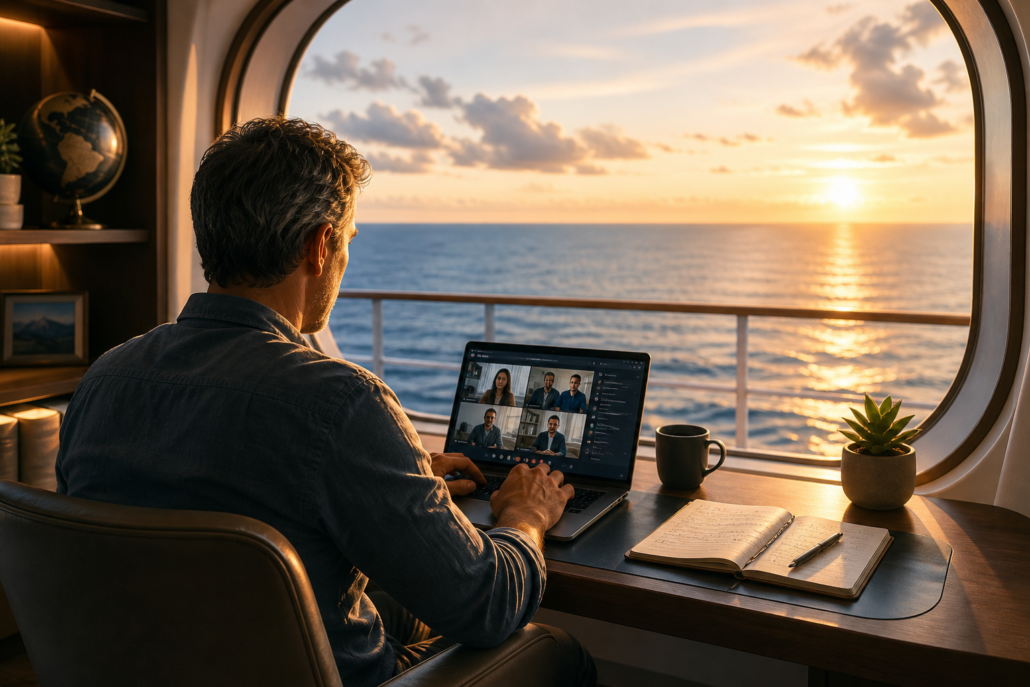

Working from the Ocean: How Remote Work Is Reshaping Life at Sea
Residential cruising used to have a single archetype: the wealthy retiree, freed from work, drifting through the world’s ports on someone else’s schedule. That archetype is dying, and what’s replacing it is more interesting.
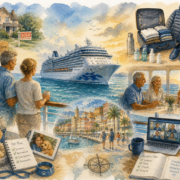
The new resident is just as likely to be a 30-something founder running a company from a balcony, a consultant on Zoom calls between Singapore and Cape Town, or an accountant logging into her firm’s systems from a suite while the ship transits the Mediterranean. Reliable maritime internet has rewired the economics of life at sea, and the live-at-sea community is feeling it.
Cruise Life as Digital Nomadism, Continued
The framing that resonates most with working-age residents is that residential cruising is simply the next chapter of a movement that already exists: digital nomadism.
“I look at cruise living as a subcategory of being a digital nomad. I am not retired, and the fact that I still need to work would alleviate much of the downside of living on a cruise ship.” — Live at Sea Community Member
The argument is simple: nomads already work from coffee shops in Lisbon, co-working spaces in Bali, and rented apartments in Mexico City. A ship is just a moving apartment with better views and pre-arranged logistics.
For someone whose income is location-independent, a residential cabin can be cheaper than maintaining a primary home plus chasing Airbnbs around the world. The ship becomes the home, the office, and the travel platform, all in one fee.
The Starlink Revolution
The single biggest change driving this shift is internet quality.
“I am 55, but the ability to work on a ship with Starlink changes the equation.” — Live at Sea Community Member
Maritime Starlink and similar low-latency satellite systems have transformed what’s possible at sea. Five years ago, ship internet meant slow email, intermittent connections, and surcharges that made a Zoom call a luxury. Today, video calls, cloud collaboration, and full-bandwidth participation in distributed teams are routine on most modern residential ships.
That single technological change has expanded the addressable audience for residential cruising by an order of magnitude. Anyone who can work from a laptop can now seriously consider it.
The Hybrid Model
Most working residents adopt some version of a hybrid setup: in the office or on land during port stays near home, fully remote during longer voyages.
“I’m preparing my business for a more remote setup. I’ll still be in the office when I’m in town, but when I’m onboard, I’ll be working via high-speed internet. You’ll find me on Zoom just as often.” — Colin, a Live at Sea Community Member
This model preserves the things that genuinely require physical presence (key client meetings, hands-on team time, family events) while shifting the bulk of the year onto a distributed, remote-friendly rhythm.
For business owners, the transition often forces a healthy redesign:
- Tighter delegation to on-the-ground leaders
- Cleaner documentation and SOPs
- Better async communication systems
- More structured meeting cadences
- Cloud-first infrastructure
These are the same upgrades remote-first companies have been making for years. Residential cruising just provides the forcing function.
A New Category of Resident: The Working Owner
Worth naming explicitly because it changes how the lifestyle is sold:
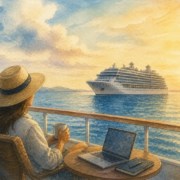
The classic residential cruise pitch is built around freedom from work. The new pitch is freedom with work. You’re not retiring; you’re relocating your office to a moving address.
“More like a second home? In this case, the ship would be a primary home, and we would return to land to a much smaller footprint and for limited time.” — Rob, a Live at Sea Community Member
That reframes the whole financial picture. If you’re still earning, the cabin doesn’t have to be funded entirely from savings. Income offsets cost. The math gets meaningfully friendlier.
The Age Range Is Dropping
Operators have historically targeted the 65+ demographic, and that audience still represents the largest share of buyers. But the working-age cohort is real and growing.
“I don’t know how old you are, but the average age on Villa Vie Odyssey is around 60. There are many in their 50s on the ship living very actively.” — Theresa, a Live at Sea Community Member
Expect that average to drop further as remote work normalizes and as ships explicitly cater to working residents: better Wi-Fi, more co-working spaces aboard, dedicated quiet zones, and time-zone-friendly programming.
The Practical Setup
If you’re planning to work from a residential cruise, the community’s collective advice converges on a few essentials:
1. Test your bandwidth needs honestly. Run a typical workday off your phone’s mobile hotspot for a week. If your work survives that, you’ll be fine on Starlink. If it doesn’t, identify which workflows fail and plan around them.
2. Build a port-day rhythm. Use port days for in-person meetings, document signings, banking, and anything that requires physical presence in a major city.
3. Design for time zones. If your team is based in one region, plan your itinerary so you’re not constantly waking up at 3 AM for calls. Some residents intentionally choose itineraries that align with their work hours.
4. Get the cabin layout right. A separate living area, a real desk, and good lighting matter more than balcony size when you’re working from the unit forty hours a week.
5. Build redundancy. Have a second connectivity option for critical calls, most residents pair the ship’s Wi-Fi with cellular data for redundancy in port.
The Bigger Shift
What’s happening here is bigger than a few entrepreneurs working from cruise cabins. Residential cruising is quietly becoming a legitimate option in the menu of remote-work lifestyles, alongside RV living, slow travel, and digital nomad hubs.
Less stuff. Smaller home base. Bigger world. Same career.
For a generation that’s increasingly skeptical of staying put, a moving home is starting to look less like an indulgence and more like an obvious choice.
Are You Working from the Ocean?
If you’re already running a business or a career from a residential ship, or planning to, the community needs your input. Share what’s working, what isn’t, and the lessons you wish someone had given you before you boarded.