

Would People Really Live at Sea Full-Time?
People talk a lot about the concept of living at sea, but one question comes up more than almost any other:
Would people actually live onboard year-round?
The answer, according to a recent Live at Sea community poll, is yes , and by a larger margin than many people expected.
When community members were asked how many months per year they would realistically live onboard a cruise residence, the single largest group selected 12 months per year.
In other words, full-time living at sea.
That option received 38% of the total vote.
That number surprised a lot of people. After all, most people still view cruise ships primarily as vacation experiences rather than permanent residences. But as the residential cruising concept gains momentum, perceptions appear to be shifting.
What makes the poll especially interesting is the broader breakdown.
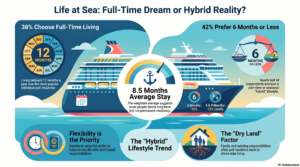
While 38% said they would happily live onboard year-round, another 20% selected between 7 and 11 months annually. Meanwhile, 42% said they would spend six months or less onboard.
When all responses were averaged together, the community landed at roughly 8.5 months per year living at sea.
That number may ultimately represent the sweet spot for residential cruising.
Rather than replacing land life entirely, many people appear to envision a hybrid lifestyle , part floating residence, part traditional home base.
That makes sense for several reasons.
Family obligations, healthcare access, business commitments, and personal routines still tie many people to life on land. Even among enthusiastic supporters of residential cruising, there’s recognition that full-time ship life may not fit every stage of life equally.
Yet the poll also demonstrates something important:
The idea is no longer viewed as unrealistic.
Only a few years ago, the concept of spending most of the year living aboard a cruise ship would have sounded extreme to the average person. Today, a large percentage of this community views it as not only possible, but desirable.
A few things are probably contributing to that shift in thinking.
First, remote work has fundamentally altered how many people think about location. For growing numbers of professionals, work is no longer tied to a single city or office. Reliable internet and flexible schedules have opened the door to more mobile lifestyles.
Second, many people are rethinking what “home” actually means.
Traditional homeownership comes with rising costs, maintenance responsibilities, taxes, insurance, and geographic limitations. Residential cruising offers an alternative model built around mobility, simplicity, and experience.
Instead of mowing lawns or dealing with winter weather, residents imagine waking up in Greece, Japan, South America, or Alaska.
That emotional appeal is powerful.
At the same time, the poll suggests that most people still value balance.
The fact that 42% selected six months or less indicates many residents may initially approach ship life gradually rather than diving into permanent residency immediately.
That’s probably healthy.
Residential cruising doesn’t need every resident to commit to 365 days per year in order to succeed. In fact, flexibility may become one of the model’s biggest strengths.
Some residents may spend winters onboard and summers near family. Others may rotate between multiple residences throughout the year. Retirees, entrepreneurs, digital nomads, and part-time travelers may all use residential cruising differently.
The key insight from the poll is that people are actively imagining how this lifestyle could fit into their real lives.
That’s a major shift.
The idea is starting to move from fantasy into something people can realistically picture themselves doing.
People are beginning to ask:
How long would I stay?
Which destinations would matter most?
What kind of community would I want onboard?
How would healthcare, fitness, dining, and social life work long-term?
Those are the kinds of questions people ask when an idea starts feeling real.
And based on this poll, living at sea is beginning to feel very real to a growing number of people.