

Residential Cruise Condo Rentals: Poll Shows People Would Stay 6 to 7 Months
How Long Would People Rent a Residential Cruise Condo?
I recently asked a simple question in our Live at Sea community:
If you were to rent a residential cruise condo, how many months would you rent it for?
The results were fascinating.
The largest group, 32%, said they would rent for 1 to 3 months. Another 21% said 7 to 9 months, and another 21% said more than 12 months. Only 10% said they would rent for less than a month.
When you average out the results using the midpoint of each range, the average rental period comes out to roughly 6 to 7 months.
That is very different from the traditional cruise market. According to CLIA’s 2024 global report, the worldwide average cruise length was 7.1 days. (cruising.org) Here, we are not talking about a one-week vacation. We are talking about people considering a lifestyle experiment measured in months.
That is the real opportunity.
Today, renting a residential cruise condo in the same way someone rents a luxury Airbnb home is not yet a mature market. There are early rental programs beginning to appear, including Villa Vie’s segment rental and rent-to-own options, which the company advertises from 35-day segments and month-to-month rent-to-own programs. (Villa Vie Residences) Avora is also entering the market with Lumina, a residential ship focused on ownership at sea. (Avora Residences)
But the broader rental ecosystem is still in its infancy.
That will likely change as more residential cruise inventory comes online. As supply grows through companies like Villa Vie and Avora Lumina, more owners may want to rent out their residences when they are not using them. And more travelers may want to test the lifestyle before buying.
This is similar to what happened in luxury vacation homes. I currently run an Airbnb business with luxury homes in South Florida, renting to families, retirees, and other qualified guests. But we are very selective. We do not allow parties. We require guests to be at least 25 years old. They also need to have a strong Airbnb rating.
I believe residential cruise condo rentals will need the same kind of standards.
This is not a party cruise. It is someone’s home. It may also be part of a tight-knit community at sea. Owners, operators, and residents will want renters who respect the property, the crew, and the lifestyle.
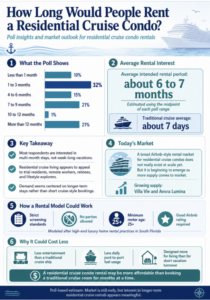
There may also be a strong economic case for renting. A residential cruise condo could end up being less expensive on a long-term basis than booking a traditional cruise cabin for months at a time. The model is different. Residential ships may have less entertainment, less daily turnover, and potentially lower fuel costs because they are not necessarily racing from port to port every day.
Traditional cruises are built around short vacations. Residential ships are built around living.
And based on this poll, the demand may not be for a week or two. It may be for half a year.
The future of cruising may not just be people buying cabins at sea. It may be people renting them first, testing the lifestyle, and discovering that home does not always have to stay in one place.
Colin C. Campbell
How long would people rent a residential cruise condo?
Based on the poll results, the average intended rental period is roughly 6 to 7 months. The strongest response was 1 to 3 months, but a meaningful number of respondents said they would rent for 7 to 9 months or even more than 12 months.
Is there currently a rental market for residential cruise condos?
A broad Airbnb-style rental market for residential cruise condos does not really exist at scale yet. However, as more residential cruise inventory comes to market through companies such as Villa Vie and Avora Lumina, rentals may become more common.
Why would someone rent a residential cruise condo instead of buying one?
Renting gives someone a way to test the lifestyle before committing to ownership. It may appeal to retirees, remote workers, families, lifestyle explorers, and people who want to experience living at sea for several months without making a long-term purchase.
Would renting a residential cruise condo be cheaper than a traditional cruise?
It could be less expensive for longer stays. A residential cruise ship may have less entertainment, less daily port-to-port movement, and a model designed more around living than short vacation turnover. That could make monthly residential rentals more affordable than booking a traditional cruise room for months at a time.
What kind of rental standards would make sense for residential cruise condos?
A strong rental model would likely need strict screening standards. That could include no parties, a minimum renter age such as 25 years old, and a good rental history or Airbnb rating. Since these units are homes, not just vacation cabins, owners and operators will likely want responsible renters.
Who is most likely to rent a residential cruise condo?
The most likely renters may include retirees, remote workers, long-term travelers, families testing the lifestyle, and people who want a more flexible way to live at sea. The poll suggests interest is strongest for multi-month stays rather than short one-week vacations.