Tag Archive for: full-time cruise living

Living at Sea: One Resident Explains Why She’ll Never Take Another Cruise

Why one Villa Vie Odyssey resident says living at sea is an entirely different lifestyle

For most people, a world cruise is the ultimate travel experience.

For Holly Hennessey, it was only the beginning.

After completing three world cruises and spending the equivalent of years at sea as a passenger, Holly finally made the move she had dreamed about for decades: selling the idea of vacations at sea in favor of living aboard the Villa Vie Odyssey full time. And according to her, there’s no going back.

“I Hope I Never Have to Take Another Cruise Again.”

That might sound surprising coming from someone who loves cruising.

Holly still appreciates the elegance of traditional cruise lines like Cunard. But after experiencing residential cruising, she sees conventional cruises very differently.

“It’s home,” she explains.

Instead of rushing through destinations with just a few hours in port, Odyssey residents often spend several days exploring each location. Bangkok? Five days. Koh Samui? Four days. The schedule is built around living, not sightseeing.

That simple difference changes everything.

Home Doesn’t Sail Away Every Week

Traditional cruise passengers pack for a vacation.

Residential cruise residents unpack for life.

Holly has personalized her cabin with artwork, clothing storage, favorite spaces to relax, and even accommodations for Captain, her famous cruising cat. It isn’t a hotel room anymore. It’s simply home.

She says she spends plenty of time in her suite because that’s exactly what people do in their homes.

The Community Forms Naturally

One of the biggest surprises for many people considering life at sea is the social aspect.

On vacation cruises, friendships often last a week before everyone flies home.

On a residential ship, relationships continue for months or years.

Residents have created everything from yacht clubs and poker nights to scuba groups and countless other resident-led activities. The community isn’t organized by the cruise line—it’s built by the people who live there.

Interestingly, Holly says the challenge isn’t making friends.

It’s finding enough quiet time.

Fortunately, that’s respected too.

Whether someone wants to eat breakfast alone or spend an evening with friends, everyone understands that balance.

No Crowds. No Lines. No Rush.

Ask almost anyone what frustrates them about large cruise ships and you’ll hear similar complaints:

  • Crowded buffets
  • Busy pools
  • Long lines
  • Constant embarkation and disembarkation chaos

Holly says that’s one of the biggest differences aboard Odyssey.

Most days, the hot tubs are empty. Restaurants rarely have lines. Public spaces remain peaceful because everyone isn’t arriving and leaving on the same schedule.

The ship feels more like a neighborhood than a resort.

Solo Travelers Are Thriving

Many people assume residential cruising is mostly for retired couples.

The reality looks different.

According to resident statistics shared aboard Odyssey, roughly 64% of residents are solo travelers.

For people who enjoy traveling independently but still want a built-in community, residential cruising offers something unique.

You can socialize every day.

Or not.

Either choice feels completely normal.

The Ship Becomes Your Transportation

One insight Holly shared stands out.

She doesn’t think of Odyssey as a destination.

She thinks of it as transportation.

Residents regularly leave the ship for several days—or even weeks—to explore inland destinations before rejoining the ship farther along its itinerary. Others stay in hotels during extended port visits or head off on African safaris before returning home to their cabin.

Instead of planning dozens of expensive international flights every year, the ship quietly moves from country to country while your home comes with you.

The Moments That Matter Most

After visiting much of the world, Holly says it isn’t the famous landmarks she remembers most.

It’s the people.

Whether it’s being welcomed into small communities rarely visited by tourists or sharing an unexpected hug with a woman in Rio’s favelas despite speaking different languages, those human moments have become the true reward of life at sea.

As she puts it, traveling this way reminds you that people everywhere are trying to build good lives for themselves and their families.

Would She Do It Again?

Without hesitation.

Holly dreamed of living aboard a ship after meeting a full-time resident during a world cruise back in 2003.

More than twenty years later, she finally made it happen.

Her advice to anyone considering the lifestyle?

“Take the leap. You won’t be sorry.”

The Future of Residential Cruise Ships: Three Ships. Three Visions.

Which One Would You Choose to Call Home?

As the concept of living at sea continues to evolve, one question keeps coming back to me:

What makes the perfect residential cruise ship?

Is it intimacy? Size? Amenities? Stability? Entertainment? Access to small ports? Or is it something more?

I’m writing this while aboard Celebrity Equinox on a 20-day Mediterranean cruise. Like most large cruise ships, it offers incredible amenities, but I still find the crowds to be a bit much. Fortunately, we’ve been able to escape some of that by spending much of our time in The Retreat, Celebrity’s suite enclave.

That experience reinforced something I’d already noticed over the years. Some of our favorite cruises have been aboard smaller ultra-luxury ships from Regent Seven Seas and Silversea. They simply feel more personal. The service is more intimate, the atmosphere is quieter, and the ship itself begins to feel less like a resort and more like home.

Then, while docked in Malta, I spotted the Emerald Azzurra tied up beside us.

My first thought was, “That would be an incredible ship to live on.”

But then I started asking myself the harder questions.

Would I enjoy the intimacy of such a small ship? Would I miss having multiple restaurants? Could I live with more motion at sea? Would the limited amenities eventually become a drawback?

It made me realize there probably isn’t one perfect residential cruise ship. There may actually be three very different visions of what life at sea could become.

The Emerald Azzurra Ship Docked in Malta.

Image from my room of the Emerald Azzurra in Malta.


Vision One: The Private Yacht

Imagine stepping aboard a vessel with fewer than 100 residents.

There are no crowds, no long corridors, and no waiting for elevators. Within a few days, you know nearly everyone by name.

This isn’t just a ship. It feels like a floating private estate.

The Emerald Azzurra excels at delivering an intimate lifestyle. Its greatest strength is its ability to reach destinations that larger vessels simply cannot. Tiny Greek islands, Croatian fishing villages, hidden Mediterranean coves, and boutique marinas become your neighborhood.

Outdoor living becomes the centerpiece. Residents spend afternoons swimming directly from the marina platform, paddleboarding in crystal-clear water, or enjoying sunset cocktails on open decks that never feel crowded. To me, that’s what makes this style of ship so appealing.

For those seeking privacy and exclusivity, this yacht would be hard to surpass.

The tradeoffs are simply the result of its size. There are fewer restaurants, a smaller fitness center, and more limited public spaces. While that may be perfect for a vacation, I wonder whether I would miss the variety after living aboard for several years.

Today, Emerald Azzurra isn’t designed as a residential ship, but it certainly has a residential feel. Another reality is that smaller ships are generally more expensive to operate on a per-resident basis. There really are economies of scale at work. Smaller ships also tend to have smaller staterooms, making every square foot even more valuable.

Avora Lumina Ship

Image from Avora Lumina blog


Vision Two: Small-Ship Luxury

Now imagine something entirely different.

Not a cruise ship.

Not a yacht.

A purpose-built residential community that happens to travel the world.

Using the elegant Seven Seas Navigator as the foundation, Avora Lumina represents what I believe may be the sweet spot between intimacy and capability.

With a few hundred residences instead of just a few dozen, the ship becomes large enough to support world-class amenities while remaining small enough to foster genuine community.

Residents could enjoy multiple restaurants, wellness facilities, a medical clinic, coworking spaces, libraries, lecture halls, a theater, fitness facilities, cafés, lounges, and bars, all while still feeling like they are coming home instead of checking into another cruise.

Unlike traditional cruise ships, every design decision is made for permanent residents rather than vacation guests.

That creates opportunities for stronger friendships, lifelong learning, entrepreneurship, wellness, and shared adventures around the globe.

It becomes a community that moves together.

Celebrity Equinox Ship

Image from a tender of the Celebrity Equinox


Vision Three: The Floating City

During my research, I also came across another residential concept that appears to be targeting a much larger ship, advertising approximately 1,200 residences.

The company has not yet announced which vessel it intends to purchase, so for the sake of comparison, let’s imagine a converted MSC Rhapsody (which is currently for sale if you have 95M), similar to the ship I am traveling on while writing this article, the Celebrity Equinox 

Here, scale becomes the defining advantage.

A ship of this size could support an astonishing range of amenities, including:

  • Numerous restaurants and cafés
  • Resort-style spas
  • Indoor gardens
  • Walking promenades
  • Art and cooking studios
  • Conference facilities
  • Educational spaces
  • Comprehensive medical services
  • Entertainment venues
  • Sports facilities

Rather than resembling a yacht, it begins to feel like an elegant neighborhood at sea.

Its size also creates operational efficiencies. More residents allow maintenance costs to be spread across a much larger ownership base, potentially lowering costs per residence while dramatically expanding available amenities.

Of course, there are tradeoffs.

Larger ships cannot visit many of the world’s smaller ports, and the intimate atmosphere naturally gives way to a more diverse metropolitan community.

In many ways, it’s the difference between living in a vibrant downtown city and living in a quiet coastal village. Neither is better. They’re simply different lifestyles.

Three Different Dreams

None of these concepts is objectively better than the others.

They simply appeal to different people.

If your dream is to own a residence aboard a private yacht where everyone knows your name, the Emerald Azzurra offers something truly special.

If your vision is a balanced life of luxury, exploration, wellness, and community, Avora Lumina may represent the ideal middle ground.

If you imagine a vibrant floating city with endless amenities and an active social scene, a larger converted ocean liner opens up possibilities that smaller ships never could.

A New Category of Living

For decades, people have debated where to retire, where to invest, and where to build their dream home.

Perhaps the more interesting question is no longer “Where?”

Perhaps it’s “Why should home stay in one place?”

Residential cruise ships are no longer just an intriguing idea. They are becoming an entirely new category of real estate, where your address changes, your neighbors become lifelong friends, and the world itself becomes your backyard.

After standing on the deck of Celebrity Equinox, looking across at the Emerald Azzurra, and imagining what a converted Seven Seas Navigator or a much larger residential ship could become, I’ve come to one conclusion.

There probably isn’t one perfect residential cruise ship.

There are simply different visions of the same dream.

Some people will want the intimacy of a private yacht. Others will want the balance of a purpose-built residential community. Still others will embrace the energy and amenities of a floating city.

The one thing that connects all of these concepts is the freedom to wake up somewhere extraordinary tomorrow.

And perhaps that’s the greatest luxury of all.

Residential Cruise Condo Rentals: Poll Shows People Would Stay 6 to 7 Months

How Long Would People Rent a Residential Cruise Condo?

I recently asked a simple question in our Live at Sea community:

If you were to rent a residential cruise condo, how many months would you rent it for?

The results were fascinating.

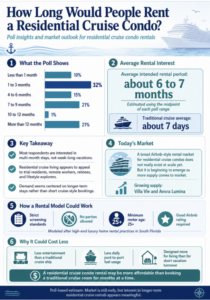
The largest group, 32%, said they would rent for 1 to 3 months. Another 21% said 7 to 9 months, and another 21% said more than 12 months. Only 10% said they would rent for less than a month.


When you average out the results using the midpoint of each range, the average rental period comes out to roughly 6 to 7 months.

That is very different from the traditional cruise market. According to CLIA’s 2024 global report, the worldwide average cruise length was 7.1 days. (cruising.org) Here, we are not talking about a one-week vacation. We are talking about people considering a lifestyle experiment measured in months.

That is the real opportunity.

Today, renting a residential cruise condo in the same way someone rents a luxury Airbnb home is not yet a mature market. There are early rental programs beginning to appear, including Villa Vie’s segment rental and rent-to-own options, which the company advertises from 35-day segments and month-to-month rent-to-own programs. (Villa Vie Residences) Avora is also entering the market with Lumina, a residential ship focused on ownership at sea. (Avora Residences)

But the broader rental ecosystem is still in its infancy.

That will likely change as more residential cruise inventory comes online. As supply grows through companies like Villa Vie and Avora Lumina, more owners may want to rent out their residences when they are not using them. And more travelers may want to test the lifestyle before buying.

This is similar to what happened in luxury vacation homes. I currently run an Airbnb business with luxury homes in South Florida, renting to families, retirees, and other qualified guests. But we are very selective. We do not allow parties. We require guests to be at least 25 years old. They also need to have a strong Airbnb rating.

I believe residential cruise condo rentals will need the same kind of standards.

This is not a party cruise. It is someone’s home. It may also be part of a tight-knit community at sea. Owners, operators, and residents will want renters who respect the property, the crew, and the lifestyle.

There may also be a strong economic case for renting. A residential cruise condo could end up being less expensive on a long-term basis than booking a traditional cruise cabin for months at a time. The model is different. Residential ships may have less entertainment, less daily turnover, and potentially lower fuel costs because they are not necessarily racing from port to port every day.

Traditional cruises are built around short vacations. Residential ships are built around living.

And based on this poll, the demand may not be for a week or two. It may be for half a year.

The future of cruising may not just be people buying cabins at sea. It may be people renting them first, testing the lifestyle, and discovering that home does not always have to stay in one place.


Colin C. Campbell


How long would people rent a residential cruise condo?

Based on the poll results, the average intended rental period is roughly 6 to 7 months. The strongest response was 1 to 3 months, but a meaningful number of respondents said they would rent for 7 to 9 months or even more than 12 months.

Is there currently a rental market for residential cruise condos?

A broad Airbnb-style rental market for residential cruise condos does not really exist at scale yet. However, as more residential cruise inventory comes to market through companies such as Villa Vie and Avora Lumina, rentals may become more common.

Why would someone rent a residential cruise condo instead of buying one?

Renting gives someone a way to test the lifestyle before committing to ownership. It may appeal to retirees, remote workers, families, lifestyle explorers, and people who want to experience living at sea for several months without making a long-term purchase.

Would renting a residential cruise condo be cheaper than a traditional cruise?

It could be less expensive for longer stays. A residential cruise ship may have less entertainment, less daily port-to-port movement, and a model designed more around living than short vacation turnover. That could make monthly residential rentals more affordable than booking a traditional cruise room for months at a time.

What kind of rental standards would make sense for residential cruise condos?

A strong rental model would likely need strict screening standards. That could include no parties, a minimum renter age such as 25 years old, and a good rental history or Airbnb rating. Since these units are homes, not just vacation cabins, owners and operators will likely want responsible renters.

Who is most likely to rent a residential cruise condo?

The most likely renters may include retirees, remote workers, long-term travelers, families testing the lifestyle, and people who want a more flexible way to live at sea. The poll suggests interest is strongest for multi-month stays rather than short one-week vacations.


Would People Really Live at Sea Full-Time?

People talk a lot about the concept of living at sea, but one question comes up more than almost any other:

Would people actually live onboard year-round?

The answer, according to a recent Live at Sea community poll, is yes , and by a larger margin than many people expected.

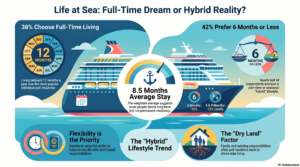
When community members were asked how many months per year they would realistically live onboard a cruise residence, the single largest group selected 12 months per year.

In other words, full-time living at sea.

That option received 38% of the total vote.

That number surprised a lot of people. After all, most people still view cruise ships primarily as vacation experiences rather than permanent residences. But as the residential cruising concept gains momentum, perceptions appear to be shifting.

What makes the poll especially interesting is the broader breakdown.

While 38% said they would happily live onboard year-round, another 20% selected between 7 and 11 months annually. Meanwhile, 42% said they would spend six months or less onboard.

When all responses were averaged together, the community landed at roughly 8.5 months per year living at sea.

That number may ultimately represent the sweet spot for residential cruising.

Rather than replacing land life entirely, many people appear to envision a hybrid lifestyle , part floating residence, part traditional home base.

That makes sense for several reasons.

Family obligations, healthcare access, business commitments, and personal routines still tie many people to life on land. Even among enthusiastic supporters of residential cruising, there’s recognition that full-time ship life may not fit every stage of life equally.

Yet the poll also demonstrates something important:

The idea is no longer viewed as unrealistic.

Only a few years ago, the concept of spending most of the year living aboard a cruise ship would have sounded extreme to the average person. Today, a large percentage of this community views it as not only possible, but desirable.

A few things are probably contributing to that shift in thinking.

First, remote work has fundamentally altered how many people think about location. For growing numbers of professionals, work is no longer tied to a single city or office. Reliable internet and flexible schedules have opened the door to more mobile lifestyles.

Second, many people are rethinking what “home” actually means.

Traditional homeownership comes with rising costs, maintenance responsibilities, taxes, insurance, and geographic limitations. Residential cruising offers an alternative model built around mobility, simplicity, and experience.

Instead of mowing lawns or dealing with winter weather, residents imagine waking up in Greece, Japan, South America, or Alaska.

That emotional appeal is powerful.

At the same time, the poll suggests that most people still value balance.

The fact that 42% selected six months or less indicates many residents may initially approach ship life gradually rather than diving into permanent residency immediately.

That’s probably healthy.

Residential cruising doesn’t need every resident to commit to 365 days per year in order to succeed. In fact, flexibility may become one of the model’s biggest strengths.

Some residents may spend winters onboard and summers near family. Others may rotate between multiple residences throughout the year. Retirees, entrepreneurs, digital nomads, and part-time travelers may all use residential cruising differently.

The key insight from the poll is that people are actively imagining how this lifestyle could fit into their real lives.

That’s a major shift.

The idea is starting to move from fantasy into something people can realistically picture themselves doing.

People are beginning to ask:

How long would I stay?

Which destinations would matter most?

What kind of community would I want onboard?

How would healthcare, fitness, dining, and social life work long-term?

Those are the kinds of questions people ask when an idea starts feeling real.

And based on this poll, living at sea is beginning to feel very real to a growing number of people.