Live at Sea (Rent or Buy) Facebook Group: A Place to Rent, Buy, Dream, and Gawk

For many people, the idea of living at sea still feels like a fantasy. Waking up to a new horizon, spending weeks or months aboard a ship, and calling the ocean home sounds almost too good to be real.

But for some people, it is already happening.

That is why I created the Live at Sea (Rent or Buy) Facebook Group. It is a sister group to the main Live at Sea Facebook Group, and its purpose is simple: to give people a dedicated place to explore cruise condos, ship residences, and live-at-sea opportunities that are available for rent or purchase.

A lot of us are curious about what is out there. Some are seriously looking to buy. Others want to rent before making a bigger commitment. And plenty of us just enjoy seeing the different options, layouts, ships, destinations, and lifestyles that are becoming available. Let’s be honest, it is quite fun to gawk at all the possibilities. Humanity has turned “window shopping” into a full-time hobby, so we may as well do it with ocean views.

This group is designed for people who want to promote a unit for sale or rent, as well as those who are interested in finding one. If you have a residence, cabin, or cruise condo available, you are welcome to post it here. If someone is interested, the two parties can connect directly through private message and work out the details privately.

My wife and I recently bought a place on Avora Lumina, and we expect that we may rent it out from time to time. We also intend to rent Villa Vie when she reaches Europe. That experience made me realize there should be an easier place for people in this niche community to share listings, compare options, and connect with others who are interested in this lifestyle.

The live-at-sea movement is still young, but it is growing quickly. More ships, more ownership models, more rental opportunities, and more creative ways to live aboard are appearing all the time. Some people are looking for adventure. Some are looking for a more flexible retirement. Some want to see the world without constantly packing and unpacking. And some are just curious enough to follow along until the right opportunity appears.

The Live at Sea (Rent or Buy) Facebook Group is for all of those people. Join here now.

Whether you are ready to buy, hoping to rent, listing your own unit, or simply enjoying the view from your screen, welcome aboard.

Storylines Cruise Ship Update: Restructuring, Refund Delays and Another Funding Push

By Liveatsea.com Staff
May 2026

Storylines’ latest resident update was meant to reassure buyers. Instead, it confirmed the central issue surrounding MV Narrative: the company is still trying to complete the financial structure needed to move its long-promised residential ship forward.

In a May 2026 video update, Storylines co-founder and CEO Alister Punton said the company has been focused on restructuring, a “go shop notice,” refund questions, recapitalization, and efforts to close the balance of project funding. He also said Storylines had stood down all but its core operations and construction teams to preserve capital.

That is not a normal construction update. It is a restructuring update with a ship attached.

The company’s previously discussed 2027 timing is no longer the real story, especially since Storylines’ own current messaging has shifted toward 2028; the bigger issue now is whether the company can finalize financing and bring the shipbuilding contract fully into force.

Financing Has Been the Story Since 2023

The financing issue is not new.

Storylines has been trying to secure the capital structure for MV Narrative since at least October 2023. Since then, the project has continued to move through revised timelines, funding discussions, and resident updates centered on financing.

In the May 2026 update, Alister described the recapitalization as “step one.” Step two, he said, is to close the balance of the funding through a new partner. That partner has not yet been named.

That does not mean the ship will not be built. It does mean the central question remains unresolved: where is the completed financing?

Refunds Remain a Sensitive Issue

Alister also addressed refunds directly.

For people waiting on refunds outside the trust account, primarily the $10,000 refundable deposits, he asked them to “hold on a little bit longer.” He said those refunds would be released once restructuring frees up capital or brings more capital into the company.

For residents who were “short” on trust account refunds, he said there is a process to recover the balance and that information would be sent directly to affected people.

The $500 Million Bank Guarantee

The biggest financial claim in the update was Alister’s statement that Storylines has access to a “significant investor” who has put up a $500 million cash-backed bank guarantee. He said the company is working to secure a facility to monetize that guarantee and has “a couple of options” under consideration.

That distinction matters.

A bank guarantee that still needs to be monetized is not the same as closed construction financing sitting in the company’s account.

Alister also referred to a $900 million insurance wrap over the project and refund guarantees from the shipyard state. Liveatsea.com has not independently reviewed those instruments.

Shipyard Progress, But the Main Question Remains

Alister said Storylines recently completed hull design verification through tank testing in Holland. He described the testing as successful, with only minor changes. He also said the company has a secondary shipyard option for future planning and geopolitical backup.

That is a green flag. Technical progress matters.

But tank testing does not solve the larger question: whether the project is fully financed and whether the shipbuilding contract is fully in force.

Avora Enters the Picture

Alister also said Storylines has put together a program with Avora, which he expects to release to residents and friends of Storylines. He suggested residents considering Avora or Villa Vie should speak with Storylines because Storylines could secure a better deal than going directly.

That may provide residents with another path to life at sea. It may also suggest that Storylines is looking for ways to keep its community engaged while MV Narrative remains delayed.

Green Flags

There are still positives.

Storylines is communicating with residents. The company is acknowledging restructuring rather than pretending everything is normal. Alister described a sequence for moving forward: recapitalization first, then closing the remaining funding. He also reported successful hull tank testing and said the company has a secondary shipyard option.

Those are not meaningless developments.

Red Flags

The red flags are harder to ignore.

Storylines has stood down most of its team. Some refunds are tied to future capital becoming available. The recapitalization has not been announced as completed. The new partner has not been named. The investor behind the claimed $500 million bank guarantee has not been named. The guarantee still needs to be monetized. The insurance wrap has not been independently verified.

None of that proves MV Narrative will not be built.

But it does show that the company is still not at the finish line on the one issue that matters most: funding.

Bottom Line

Alister’s May 2026 update shows that Storylines is still trying to restructure, recapitalize, and finance MV Narrative.

The company says key pieces are coming together: a recapitalization, a new partner, a $500 million bank guarantee, a $900 million insurance wrap, refund guarantees, and successful hull tank testing. But based on the same update, Storylines has not announced completed financing, has not named the partner or investor, and still needs to monetize the bank guarantee.

For residents and prospective buyers, the practical questions remain simple:

When will refunds be paid? Has financing closed? Who is the new partner? Has the bank guarantee been monetized? Is the shipbuilding contract fully in force? And what is the real launch date?

Until those questions are answered clearly and in writing, the safest reading is this:

MV Narrative may still be alive, but it is not yet financially secured.

That is not a launch update. It is a funding update, and a very late one.

Residential Cruise Condo Rentals: Poll Shows People Would Stay 6 to 7 Months

How Long Would People Rent a Residential Cruise Condo?

I recently asked a simple question in our Live at Sea community:

If you were to rent a residential cruise condo, how many months would you rent it for?

The results were fascinating.

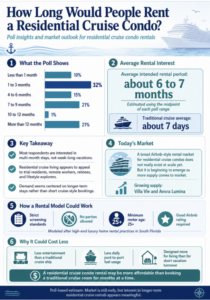
The largest group, 32%, said they would rent for 1 to 3 months. Another 21% said 7 to 9 months, and another 21% said more than 12 months. Only 10% said they would rent for less than a month.


When you average out the results using the midpoint of each range, the average rental period comes out to roughly 6 to 7 months.

That is very different from the traditional cruise market. According to CLIA’s 2024 global report, the worldwide average cruise length was 7.1 days. (cruising.org) Here, we are not talking about a one-week vacation. We are talking about people considering a lifestyle experiment measured in months.

That is the real opportunity.

Today, renting a residential cruise condo in the same way someone rents a luxury Airbnb home is not yet a mature market. There are early rental programs beginning to appear, including Villa Vie’s segment rental and rent-to-own options, which the company advertises from 35-day segments and month-to-month rent-to-own programs. (Villa Vie Residences) Avora is also entering the market with Lumina, a residential ship focused on ownership at sea. (Avora Residences)

But the broader rental ecosystem is still in its infancy.

That will likely change as more residential cruise inventory comes online. As supply grows through companies like Villa Vie and Avora Lumina, more owners may want to rent out their residences when they are not using them. And more travelers may want to test the lifestyle before buying.

This is similar to what happened in luxury vacation homes. I currently run an Airbnb business with luxury homes in South Florida, renting to families, retirees, and other qualified guests. But we are very selective. We do not allow parties. We require guests to be at least 25 years old. They also need to have a strong Airbnb rating.

I believe residential cruise condo rentals will need the same kind of standards.

This is not a party cruise. It is someone’s home. It may also be part of a tight-knit community at sea. Owners, operators, and residents will want renters who respect the property, the crew, and the lifestyle.

There may also be a strong economic case for renting. A residential cruise condo could end up being less expensive on a long-term basis than booking a traditional cruise cabin for months at a time. The model is different. Residential ships may have less entertainment, less daily turnover, and potentially lower fuel costs because they are not necessarily racing from port to port every day.

Traditional cruises are built around short vacations. Residential ships are built around living.

And based on this poll, the demand may not be for a week or two. It may be for half a year.

The future of cruising may not just be people buying cabins at sea. It may be people renting them first, testing the lifestyle, and discovering that home does not always have to stay in one place.


Colin C. Campbell


How long would people rent a residential cruise condo?

Based on the poll results, the average intended rental period is roughly 6 to 7 months. The strongest response was 1 to 3 months, but a meaningful number of respondents said they would rent for 7 to 9 months or even more than 12 months.

Is there currently a rental market for residential cruise condos?

A broad Airbnb-style rental market for residential cruise condos does not really exist at scale yet. However, as more residential cruise inventory comes to market through companies such as Villa Vie and Avora Lumina, rentals may become more common.

Why would someone rent a residential cruise condo instead of buying one?

Renting gives someone a way to test the lifestyle before committing to ownership. It may appeal to retirees, remote workers, families, lifestyle explorers, and people who want to experience living at sea for several months without making a long-term purchase.

Would renting a residential cruise condo be cheaper than a traditional cruise?

It could be less expensive for longer stays. A residential cruise ship may have less entertainment, less daily port-to-port movement, and a model designed more around living than short vacation turnover. That could make monthly residential rentals more affordable than booking a traditional cruise room for months at a time.

What kind of rental standards would make sense for residential cruise condos?

A strong rental model would likely need strict screening standards. That could include no parties, a minimum renter age such as 25 years old, and a good rental history or Airbnb rating. Since these units are homes, not just vacation cabins, owners and operators will likely want responsible renters.

Who is most likely to rent a residential cruise condo?

The most likely renters may include retirees, remote workers, long-term travelers, families testing the lifestyle, and people who want a more flexible way to live at sea. The poll suggests interest is strongest for multi-month stays rather than short one-week vacations.


Avora Lumina Cruise Condo Ship: Is This the Real Deal?

The latest Avora Lumina webinar pulled back the curtain a bit more on where things actually stand.

There’s progress. There’s momentum. And there are still a few gaps that have not magically solved themselves.

But after watching the update and following up directly with company president Chris Cox, I came away with one major takeaway: Avora Lumina is starting to feel less like a concept and more like something that is actually happening.

The 5-Year Plan Upgrade May Be a Game Changer

The biggest thing that stood out to me was the newly clarified option to purchase the 5-year plan and then upgrade later to life-of-ship residency.

That is a game changer because it reduces the upfront cost and risk associated with these new residential cruise concepts. I was a bit surprised by the announcement, so I reached out to Chris Cox for clarification.

He explained that the upgrade from the 5-year plan to life-of-ship residency is prorated based on time spent onboard:

“The upgrade from 5 years to life of ship is pro-rated based upon the time spent onboard. Day one through 365, upgrades would be credited at 80% of 5 year plan price, day 366 through the end of year 2 would be credited at 60%, etc.”

The bottom line is that it appears best to upgrade either before you board or before day 365 onboard.

My guess is that they were able to offer this structure because of the 9-year payout they negotiated with NCL for the ship.

Sales Progress and the Real Target

The project is currently about 15% sold, with roughly 20 months until launch.

That is respectable, but it is not exactly champagne territory.

The real goal is 35% sold before launch, which is where things start to look financially solid. A broader marketing push is kicking off this week, which feels less like a victory lap and more like a necessary gear shift.

Customization and the Upgrade Question

One of the stronger selling points is flexibility. Units can be customized, which helps this feel more like a residence and less like a dressed-up cruise cabin.

The 5-year ownership model with an upgrade option to lifetime residency also adds flexibility. Owners can apply a portion of their original purchase price toward that upgrade, based on the prorated schedule.

That said, one important question still matters: will the life-of-ship upgrade be priced at today’s rates or at whatever rates exist later?

That detail matters a lot, and right now it still feels like it is floating somewhere out at sea.

Dry Dock Timeline and Phased Conversion

The ship will go through two dry dock periods before fully becoming a residential vessel: October 2026 and December 2027.

That tells you this is not a one-step transformation. It is more of a phased evolution, which is probably realistic given the scale of what they are trying to do.

Operations and the Apollo Angle

They again confirmed that Apollo Group will be running the dining experience and hotel operations.

That is meaningful because Apollo already has a relationship with Regent Seven Seas. If that operating partnership holds, it suggests Avora is aiming to maintain a similar ultra-luxury cruise experience to what Regent delivers today.

Given the monthly fees, I think most buyers would expect that level of service.

Lifestyle Tradeoffs

No pets on this ship.

For some people, that is a minor inconvenience. For others, it is a hard stop. For my wife and me, it kind of sucks.

They did mention that pets are being considered for future ships, which is corporate-speak for “not now, maybe later.”

Expansion Plans and NCL Talks

The team is already in discussions with Norwegian Cruise Line about additional vessels.

Founder Mike Petterson said, “There are many more ships should we need it,” implying that more could eventually hit the market.

It took about two years to land the original NCL deal, which gives you a sense of how slow and complex these negotiations are. Whether Residential Cruise Holdings converts more ships or not, this is starting to look like a model: taking certain cruise ships and refitting them to become residential ships.

Expansion is clearly part of the vision, but it is not something that happens quickly or easily.

A Reminder From Villa Vie

Villa Vie came up as a quiet cautionary example.

Their ship was offline for over four years in cold layup, and getting it operational again was not exactly smooth sailing for the company. The founder now says they are 80% sold out.

It is a useful reminder that converting and reviving ships is complicated, expensive, and very easy to underestimate.

I can attest to this personally. My brother and I once thought we got a great deal on a 74-foot Ferretti yacht we bought in foreclosure. The previous owner had ignored it for two years, and it took us hundreds of thousands of dollars to try to get it back into shape.

That experience taught me that when something has been sitting too long, the purchase price is only the beginning. The real cost shows up later, usually in the form of repairs, delays, surprises, and invoices that seem to reproduce when no one is watching.

To be clear, Avora is a different situation. The ship is currently operated and maintained by NCL, with the intent of maximizing the life of the vessel. That is a very different starting point than bringing a neglected ship back from cold layup.

What Buyers Are Choosing

The Radiance suite is emerging as one of the most popular options.

At roughly 363 square feet with a balcony, it seems to land in the sweet spot between livability and price. It is not too cramped, not wildly expensive, and it has fresh air.

It’s hard to imagine living at sea without a balcony.

When my wife and I chose to buy a suite on Avora, we chose the Solstice suite simply because it had a balcony, even though it was more expensive and smaller than the option of combining two Dawn suites into roughly 600 square feet.

For us, the balcony mattered more.

That may sound like a small thing on paper, but when you are talking about living on a ship, fresh air and private outdoor space are not really luxuries. They are sanity preservation tools with nicer branding.

So, Is Avora Lumina the Real Deal?

Avora Lumina is moving forward, but it is still early.

There is real momentum, but sales need to accelerate, some key details remain unresolved, and execution is going to determine everything.

That said, I am pleasantly surprised by the level of transparency they continue to provide. That is one of the reasons I continue to feel more comfortable with this project than I might have expected at the beginning.

Readers of LiveAtSea.com or members of the Facebook group already know that my wife and I purchased a Solstice Suite on Avora. I broke down the key reasons we made that decision in this article here.

But if I had to sum up why we purchased, it comes down to this:

Community. And the fact that it really appears to be happening.

Would People Really Live at Sea Full-Time?

People talk a lot about the concept of living at sea, but one question comes up more than almost any other:

Would people actually live onboard year-round?

The answer, according to a recent Live at Sea community poll, is yes , and by a larger margin than many people expected.

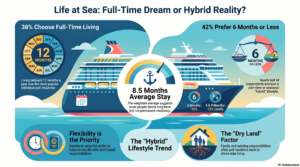
When community members were asked how many months per year they would realistically live onboard a cruise residence, the single largest group selected 12 months per year.

In other words, full-time living at sea.

That option received 38% of the total vote.

That number surprised a lot of people. After all, most people still view cruise ships primarily as vacation experiences rather than permanent residences. But as the residential cruising concept gains momentum, perceptions appear to be shifting.

What makes the poll especially interesting is the broader breakdown.

While 38% said they would happily live onboard year-round, another 20% selected between 7 and 11 months annually. Meanwhile, 42% said they would spend six months or less onboard.

When all responses were averaged together, the community landed at roughly 8.5 months per year living at sea.

That number may ultimately represent the sweet spot for residential cruising.

Rather than replacing land life entirely, many people appear to envision a hybrid lifestyle , part floating residence, part traditional home base.

That makes sense for several reasons.

Family obligations, healthcare access, business commitments, and personal routines still tie many people to life on land. Even among enthusiastic supporters of residential cruising, there’s recognition that full-time ship life may not fit every stage of life equally.

Yet the poll also demonstrates something important:

The idea is no longer viewed as unrealistic.

Only a few years ago, the concept of spending most of the year living aboard a cruise ship would have sounded extreme to the average person. Today, a large percentage of this community views it as not only possible, but desirable.

A few things are probably contributing to that shift in thinking.

First, remote work has fundamentally altered how many people think about location. For growing numbers of professionals, work is no longer tied to a single city or office. Reliable internet and flexible schedules have opened the door to more mobile lifestyles.

Second, many people are rethinking what “home” actually means.

Traditional homeownership comes with rising costs, maintenance responsibilities, taxes, insurance, and geographic limitations. Residential cruising offers an alternative model built around mobility, simplicity, and experience.

Instead of mowing lawns or dealing with winter weather, residents imagine waking up in Greece, Japan, South America, or Alaska.

That emotional appeal is powerful.

At the same time, the poll suggests that most people still value balance.

The fact that 42% selected six months or less indicates many residents may initially approach ship life gradually rather than diving into permanent residency immediately.

That’s probably healthy.

Residential cruising doesn’t need every resident to commit to 365 days per year in order to succeed. In fact, flexibility may become one of the model’s biggest strengths.

Some residents may spend winters onboard and summers near family. Others may rotate between multiple residences throughout the year. Retirees, entrepreneurs, digital nomads, and part-time travelers may all use residential cruising differently.

The key insight from the poll is that people are actively imagining how this lifestyle could fit into their real lives.

That’s a major shift.

The idea is starting to move from fantasy into something people can realistically picture themselves doing.

People are beginning to ask:

How long would I stay?

Which destinations would matter most?

What kind of community would I want onboard?

How would healthcare, fitness, dining, and social life work long-term?

Those are the kinds of questions people ask when an idea starts feeling real.

And based on this poll, living at sea is beginning to feel very real to a growing number of people.

The Longest World Cruise on a Budget: Villa Vie Launches 3-Year Global Adventure Starting at $91 Per Day

Villa Vie Residences has announced My Global Adventure, a new 3-year around-the-world cruise program designed for travelers who want to see the world without spending a fortune or living out of a suitcase for years.

The program will visit more than 400 ports across over 130 countries on all seven continents. Pricing starts at $99,999 per person for an inside residence, which works out to about $91 per day to live and travel around the world.

That number is the headline.

For less than many people spend on everyday life at home, Villa Vie is offering three years of travel, housing, meals, entertainment, community, and transportation around the globe. In a world where rent, groceries, insurance, and utilities keep climbing, the idea of trading a fixed address for 400 ports suddenly does not sound so crazy. Humanity occasionally stumbles into a good idea.

A 3-Year World Cruise Built Around Value

Most world cruises last a few months. Many top out around 120 to 180 days. Villa Vie is taking a very different approach with a full 3-year journey that circles the globe across all seven continents.

That makes My Global Adventure stand out.

This is not just a longer cruise. It is a different category of travel. It is closer to a global living program than a traditional vacation.

Starting at $99,999 per person, guests receive a private, fully furnished onboard residence for the journey. The program also includes continuous transportation to more than 400 destinations, dining options, onboard entertainment, enrichment programming, housekeeping, maintenance, Wi-Fi access, and shared amenities.

Guests may also upgrade to an outside residence for an additional $10,000 per person, adding ocean views and natural light throughout the journey.

At roughly $91 per day, the value is difficult to ignore. For travelers who already spend that much or more on housing, food, transportation, and basic living expenses, My Global Adventure offers a rare alternative: live at sea and see the world while doing it.

Six Global Boarding Gateways

Villa Vie is making the program more flexible by offering several embarkation points around the world. Guests can begin their adventure from one of six global boarding gateways:

Singapore, August 1, 2026
Singapore, November 10, 2026
Colombo, December 20, 2026
Lisbon, August 6, 2027
Barcelona, September 14, 2027
Nassau, November 20, 2027

Whether travelers want to begin in Asia, Europe, or the Americas, they can choose the starting point that fits their schedule and travel plans.

Not a Traditional Cruise

My Global Adventure is not being positioned as a standard cruise, and it should not be judged like one.

This is not a new mega-ship with waterslides, robot bartenders, and enough neon lighting to make your retinas file a complaint. Villa Vie’s ship is more of a boutique expedition-style vessel. It was built in the early 1990s, so travelers should expect a ship with character, not the polish of a brand-new luxury resort at sea.

That distinction matters.

This program is not for someone looking for the newest luxury ship on the market. It is for people who care more about the itinerary, the community, the price point, and the chance to live a much bigger life.

The ship may be dated in places. The experience is about access, adventure, and affordability, not marble staircases and champagne towers.

For the right traveler, that tradeoff may be exactly the point.

A Journey Focused on Destinations

Villa Vie says the journey is built around destinations rather than just sea days. Guests can expect extended stays in iconic cities and lesser-known ports, deeper cultural experiences across continents, and bucket-list destinations ranging from Antarctica to the Mediterranean.

“This is not a traditional cruise. It’s a completely different way to see the world,” said Mikael Petterson, Founder and Chairman of Villa Vie Residences. “When you break it down to roughly $91 per day to live and explore across this many destinations, it becomes one of the most compelling ways to experience global living today.”

Instead of coordinating flights, hotels, transfers, and luggage across dozens of countries, guests unpack once and let the world come to them.

That is the appeal. Less friction. More discovery.

What’s Included in My Global Adventure

My Global Adventure is designed as a comprehensive travel lifestyle program that combines accommodation, transportation, dining, and onboard living into one experience.

The program includes:

A private, fully furnished onboard residence for the duration of the journey
Continuous global transportation to more than 400 destinations
Dining options and onboard culinary experiences
Entertainment, enrichment programming, and social events
Wi-Fi access for remote work and connectivity
Housekeeping, maintenance, and onboard services
Access to shared amenities and community spaces

For remote workers, it offers a moving home base with access to the world. For retirees, it offers a way to turn long-postponed travel dreams into daily life. For adventurers, it offers an itinerary that would be difficult, expensive, and exhausting to recreate independently.

Living at Sea Can Change Your Life

The idea of living on a cruise ship is no longer just a fantasy. Many members of the Live at Sea Facebook group have described how the experience has changed their lives for the better.

Some talk about the freedom of leaving behind the routines and responsibilities of traditional home life. Others mention the friendships, the community, the constant sense of discovery, and the feeling of waking up with something new to look forward to each day.

That is one of the most overlooked parts of living at sea. It is not only about the destinations. It is also about the rhythm of the lifestyle.

There is less household upkeep. Less isolation. Less repetition. More movement, more connection, and more possibility.

For many people, that can be life-changing.
Why This Program Feels Different

Villa Vie continues to innovate in a market that has not changed much for years.

World cruises are not new. Long cruises are not new. Residential ships are not new either, though most remain far out of reach for the average traveler.

What feels different here is the combination of length, price, flexibility, and scale.

Three years. More than 400 ports. Over 130 countries. Seven continents. Starting at $91 per day.

There does not appear to be anything quite like this on the market right now. Most world cruises end after a few months. Villa Vie is offering a full global lifestyle program at a price that makes people stop and do the math.

And when people do the math, the program starts to look less like a fantasy and more like an option.

My Take

I think Villa Vie continues to push the market in a direction no one else seems willing to go.

This is not a luxury cruise product, and people should understand that upfront. The ship is older. It is more of a boutique expedition ship than a luxury mega-ship. Anyone expecting the newest hardware at sea may need to adjust expectations before booking.

But that may not be the point.

The real story is the value, the itinerary, and the lifestyle. A 3-year world cruise starting at $91 per day is a serious market disruptor. Most world cruises tap out at around six months, and many cost far more for a much shorter experience.

Villa Vie is offering something different: a way to live at sea, travel deeply, build community, and see the world without needing a luxury budget.

For the right traveler, this could be more than a cruise. It could be a reset. Many people in the Live at Sea community have already shared how living on a ship has changed their lives for the better. My Global Adventure gives more people a chance to find out why.

If you can live with an older ship and care more about the world outside your window than the age of the carpet under your feet, this may be one of the most interesting travel opportunities on the market today.


Click here to check it out! 

 

Working from the Ocean: How Remote Work Is Reshaping Life at Sea

Residential cruising used to have a single archetype: the wealthy retiree, freed from work, drifting through the world’s ports on someone else’s schedule. That archetype is dying, and what’s replacing it is more interesting.

The new resident is just as likely to be a 30-something founder running a company from a balcony, a consultant on Zoom calls between Singapore and Cape Town, or an accountant logging into her firm’s systems from a suite while the ship transits the Mediterranean. Reliable maritime internet has rewired the economics of life at sea, and the live-at-sea community is feeling it.

Cruise Life as Digital Nomadism, Continued

The framing that resonates most with working-age residents is that residential cruising is simply the next chapter of a movement that already exists: digital nomadism.

“I look at cruise living as a subcategory of being a digital nomad. I am not retired, and the fact that I still need to work would alleviate much of the downside of living on a cruise ship.” — Live at Sea Community Member

The argument is simple: nomads already work from coffee shops in Lisbon, co-working spaces in Bali, and rented apartments in Mexico City. A ship is just a moving apartment with better views and pre-arranged logistics.

For someone whose income is location-independent, a residential cabin can be cheaper than maintaining a primary home plus chasing Airbnbs around the world. The ship becomes the home, the office, and the travel platform, all in one fee.

The Starlink Revolution

The single biggest change driving this shift is internet quality.

“I am 55, but the ability to work on a ship with Starlink changes the equation.” — Live at Sea Community Member

Maritime Starlink and similar low-latency satellite systems have transformed what’s possible at sea. Five years ago, ship internet meant slow email, intermittent connections, and surcharges that made a Zoom call a luxury. Today, video calls, cloud collaboration, and full-bandwidth participation in distributed teams are routine on most modern residential ships.

That single technological change has expanded the addressable audience for residential cruising by an order of magnitude. Anyone who can work from a laptop can now seriously consider it.

The Hybrid Model

Most working residents adopt some version of a hybrid setup: in the office or on land during port stays near home, fully remote during longer voyages.

“I’m preparing my business for a more remote setup. I’ll still be in the office when I’m in town, but when I’m onboard, I’ll be working via high-speed internet. You’ll find me on Zoom just as often.” — Colin, a Live at Sea Community Member

This model preserves the things that genuinely require physical presence (key client meetings, hands-on team time, family events) while shifting the bulk of the year onto a distributed, remote-friendly rhythm.

For business owners, the transition often forces a healthy redesign:

  • Tighter delegation to on-the-ground leaders
  • Cleaner documentation and SOPs
  • Better async communication systems
  • More structured meeting cadences
  • Cloud-first infrastructure

These are the same upgrades remote-first companies have been making for years. Residential cruising just provides the forcing function.

A New Category of Resident: The Working Owner

Worth naming explicitly because it changes how the lifestyle is sold:

The classic residential cruise pitch is built around freedom from work. The new pitch is freedom with work. You’re not retiring; you’re relocating your office to a moving address.

“More like a second home? In this case, the ship would be a primary home, and we would return to land to a much smaller footprint and for limited time.” — Rob, a Live at Sea Community Member

That reframes the whole financial picture. If you’re still earning, the cabin doesn’t have to be funded entirely from savings. Income offsets cost. The math gets meaningfully friendlier.

The Age Range Is Dropping

Operators have historically targeted the 65+ demographic,  and that audience still represents the largest share of buyers. But the working-age cohort is real and growing.

“I don’t know how old you are, but the average age on Villa Vie Odyssey is around 60. There are many in their 50s on the ship living very actively.” — Theresa, a Live at Sea Community Member

Expect that average to drop further as remote work normalizes and as ships explicitly cater to working residents: better Wi-Fi, more co-working spaces aboard, dedicated quiet zones, and time-zone-friendly programming.

The Practical Setup

If you’re planning to work from a residential cruise, the community’s collective advice converges on a few essentials:

1. Test your bandwidth needs honestly. Run a typical workday off your phone’s mobile hotspot for a week. If your work survives that, you’ll be fine on Starlink. If it doesn’t, identify which workflows fail and plan around them.

2. Build a port-day rhythm. Use port days for in-person meetings, document signings, banking, and anything that requires physical presence in a major city.

3. Design for time zones. If your team is based in one region, plan your itinerary so you’re not constantly waking up at 3 AM for calls. Some residents intentionally choose itineraries that align with their work hours.

4. Get the cabin layout right. A separate living area, a real desk, and good lighting matter more than balcony size when you’re working from the unit forty hours a week.

5. Build redundancy. Have a second connectivity option for critical calls, most residents pair the ship’s Wi-Fi with cellular data for redundancy in port.

The Bigger Shift

What’s happening here is bigger than a few entrepreneurs working from cruise cabins. Residential cruising is quietly becoming a legitimate option in the menu of remote-work lifestyles, alongside RV living, slow travel, and digital nomad hubs.

Less stuff. Smaller home base. Bigger world. Same career.

For a generation that’s increasingly skeptical of staying put, a moving home is starting to look less like an indulgence and more like an obvious choice.

Are You Working from the Ocean?

If you’re already running a business or a career from a residential ship, or planning to, the community needs your input. Share what’s working, what isn’t, and the lessons you wish someone had given you before you boarded.

Buying a Cruise Ship Condo? Here’s Why This One Stood Out

Living at sea is no longer a fantasy. With reliable internet, a growing remote workforce, and new ownership models, it’s becoming a real option for entrepreneurs and investors.

After an initial failed attempt and exploring options like Villa Vie and The World, Colin C. Campbell and his wife landed on a different approach, one that blends lifestyle with practicality.

The decision came down to a few key factors: a community of like-minded owners, strong rental flexibility to offset costs, and a more livable, thoughtfully designed unit. Just as important, the ship itself offers longevity, ongoing upgrades, and a work-friendly environment that makes long-term living realistic.

The biggest shift is mindset. This isn’t just about travel, it’s about replacing traditional living with something more flexible, where your home moves and your life doesn’t have to pause.

It’s a bold move, but one that’s becoming increasingly viable.

Read the full breakdown, including costs, layout, and investment potential on Startup Club. 

Cost of Living on a Residential Cruise Ship vs Land: What You’re Missing

People hear “residential cruise ship” and their brains go to two places: How much does it cost? And can I afford it?

Both are the wrong question.

The better question is this: how does the true cost of living on land actually compare to life at sea when you include everything?

The Hidden Math of Land Living

Most cost comparisons between life at sea and life on land start with the wrong number,  what people think they spend on land, not what they actually spend.

When people compare the cost of living on a residential cruise ship vs land, they usually underestimate what land actually costs.

The real figure is always higher. Sales tax on most purchases. Property tax. Electricity, water, internet. Multiple insurance policies, liability, wind, flood, each its own line item. Dining out. Vacations that ironically include cruises.

When you total it honestly, the gap between what you imagine your monthly burn rate is and what it actually is gets surprisingly small.

Life on a ship bundles most of that away. No utility bills. No separate insurance riders for hurricane risk. No car. No property tax.

For many people, living on a residential cruise ship can be cheaper than living on land, but not because the ship is cheap. It’s because land is more expensive than anyone admits.

Ships Depreciate. Own That.

A cabin on a residential cruise ship is not a real estate investment. It depreciates , like a car, not like a condo.

Holly, an Odyssey resident and founder, puts it more directly. “I cringe at the term investment in conjunction with any boat, as I used to own my own. How do we encourage people to hear this instead of what they want to hear?”

That last phrase, “what they want to hear”, captures the real risk. Buyers pattern-match cabin purchases to real estate, where land appreciates and equity builds. Ships do the opposite. Hulls age. Mechanical systems wear. Even immaculately maintained vessels eventually retire.

Rob, another community member, argues the language used to sell cabins should be re-categorized entirely. “It should be labeled initiation fee, like a country club. Unlike a house or condo, you have NOTHING at the end of the term.”

Whether or not you accept the country club framing, the underlying point is worth taking seriously. Model the purchase as prepaid lifestyle, not capital investment.

The capital you put in isn’t working for you the way it would in a dividend-paying stock or a rental property. That’s a real trade-off, and the honest answer is to make it with open eyes.

The test is simple: if it were purely a financial play, institutional money would already own every unit. It doesn’t.

Because the return isn’t financial.

The Exceptions Worth Naming

There are documented cases where early buyers came out ahead,  and pretending they don’t exist would be dishonest.

Studio residences on The World sold for around $1 million when the ship launched in 2002. Today, comparable studios trade closer to $2.5 million. That’s meaningful appreciation over two decades, though it required holding through a major operational pivot in the ship’s early years.

More recently, some early buyers on Villa Vie Odyssey report cabin values up 25 to 30 percent from initial pricing. John, a Villa Vie resident, also pointed to early Storylines contracts now reportedly trading at more than twice their original price.

But these are stories about specific operators executing well over time. They are not evidence of an asset class with reliable upside. The right way to read them is as good news for early adopters who got the operator right, not as a baseline you should bake into your own decision.

If the appreciation happens for you, treat it as a bonus. If you need it to happen to make the math work, you’re buying for the wrong reasons.

The Rental Market That Hasn’t Arrived Yet

One gap in the model worth naming: short-term rental income.

Some cabin owners try to cover costs by renting their units when they leave the ship temporarily. The infrastructure for that market doesn’t really exist yet, no pricing tools, no distribution platforms, no standardized booking experience.

The demand is real, though. On a luxury residential vessel, daily maintenance fees can run around $600 for a double-occupancy unit. Comparable suites on the same class of ship rent through traditional luxury lines like Regent Seven Seas for $2,000 to $3,000 per night. If the rental infrastructure existed, the math would obviously work. Even at half those rates, fees would be covered.

But the demand-capture mechanism doesn’t exist yet, and that is the gap.

That will change. The same evolution that turned spare bedrooms into a global hospitality category will eventually reach residential ships. The timeline, though, is unknown,  and right now you can’t underwrite a cabin purchase on projected rental income. Plan around what exists today.

The Return Nobody Spreadsheets

This is the part most cost comparisons miss entirely.

No cooking. No cleaning. No driving. No airport security lines. A massage for $20 in port. Dental work for a fraction of the stateside cost. The experience of landing somewhere new and being treated as a neighbor, not a tourist passing through.

Add community. Genuine, recurring, chosen community, the kind that’s hard to manufacture on land and almost automatic when you’re 200 people living the same unusual life together.

Theresa, a Villa Vie Odyssey resident traveling with her child, reframes the entire investment question. “Living at sea and traveling is an investment in yourself. For me, it’s also an investment in my child and making priceless memories for both of us. It’s worth every damn penny.”

That reframe is the one most cost models miss. The ROI everyone tries to calculate is the wrong ROI.

Then add the world itself, experienced at a pace slow enough to actually absorb it.

None of that shows up in a cost-benefit analysis.

All of it compounds.

The Paradigm Is Shifting

It still sounds a little crazy to say you live on a ship. That’s part of what makes it interesting. Very few people on the planet have ever done it.

What’s changed is feasibility.

High-speed satellite internet, Starlink in particular, has dissolved the last real barrier for founders and remote operators. The business doesn’t have to pause. The team doesn’t have to wait.

The ship becomes just another place from which to run things, one that happens to wake up somewhere new every few days.

The Bottom Line

When you compare the cost of living on a residential cruise ship vs land, three things become clear:

First, most people underestimate what life on land actually costs.

Second, life at sea isn’t a traditional investment, the asset depreciates, exceptions are operator-specific, and there’s no reliable rental market yet.

Third, the real return isn’t financial. It’s experiential.

Life at sea isn’t for everyone. The logistics are real: travel home costs money, Medicare requires land-based access, shore excursions add up if you actually engage with the places you’re docking.

Anyone who tells you it’s purely cheaper is skipping a few line items.

But the people who thrive in it aren’t optimizing for cost.

They’re optimizing for a different life, deliberately, irreversibly, eyes wide open.

The ship is not the portfolio.

The ship is the life.

That’s what most people miss.


Quotes in the article are collected from Live at Sea community members 

Avora Cruise Residences Ask Me Anything: What We Learned, and the Reality of Living at Sea

I had the pleasure of working with Aaron Alexander and interviewing the team at Avora.

We asked tough questions and got refreshingly transparent, honest answers. It’s clear Avora is building something real and is well on its way to hitting its sales milestones.

If you’re even a little curious about cruise living, check out the full article on Startup Club and watch the Youtube video. I found it genuinely informative.