
Can You Work Remotely While Living on a Cruise Ship?
Imagine finishing your morning calls, closing your laptop, and stepping outside to explore Barcelona, Singapore, or a small island in the South Pacific.
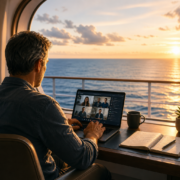
For remote workers, entrepreneurs, and consultants, living at sea can turn that fantasy into a daily routine. Modern satellite internet has made it increasingly possible to manage a business, join video meetings, and collaborate with a team while traveling the world aboard a cruise ship.
But can you really work remotely while living on a cruise ship full-time?
The short answer is yes. The more honest answer is that it works best when you choose the right ship, prepare for occasional connectivity issues, and build some flexibility into your workday.
Is Working Remotely From a Cruise Ship Realistic?
Working from a cruise ship is no longer limited to checking a few emails while on vacation. Many modern ships now offer internet capable of supporting video calls, cloud-based software, messaging platforms, and everyday online work.
Satellite systems such as Starlink have significantly improved internet access at sea. Royal Caribbean, for example, says every ship in its fleet now offers Starlink-powered Wi-Fi. Princess Cruises promotes onboard internet that supports browsing, streaming, texting, and video chats.
Residential cruise ships are also attracting people who are still actively working. Their residents may include business owners, consultants, freelancers, investors, and employees with fully remote positions.
The experience is not exactly the same as working from a fiber-connected home office. Speeds and reliability can still change depending on the ship, location, weather, number of users, and internet package. For most standard remote work, however, it is increasingly practical.
What Kind of Work Can You Do at Sea?
Jobs that are already location-independent tend to transfer most easily to cruise ship living.
That can include:
- Consulting and coaching
- Writing, editing, and content creation
- Software development
- Digital marketing
- Graphic design
- Accounting and bookkeeping
- Online teaching
- Sales and customer management
- Investing or managing rental properties
- Running an online business
- Managing a remote team
Work that depends on large, continuous file transfers, specialized equipment, highly secure networks, or uninterrupted live communication may be more difficult.
Before making a long-term commitment, think about what your job actually requires. Sending emails and editing documents is different from leading six hours of live video meetings every day.
How Reliable Is Cruise Ship Wi-Fi?
Cruise ship Wi-Fi has improved dramatically, but it should not be treated as infallible.
On many ships, routine tasks such as email, Slack, web browsing, document editing, social media, and standard video calls are possible. The connection may be available in your cabin and throughout common areas, although performance can vary by location onboard.
Remote workers should ask several questions before choosing a cruise or residential ship:
- What satellite internet system does the ship use?
- Is internet included or charged separately?
- Are there different service tiers?
- Does the plan support video conferencing?
- Are there limits on devices, data, or streaming?
- Does the ship restrict VPNs or certain websites?
- Is Wi-Fi available inside the cabin?
- Is technical support available onboard?
Do not rely only on a general promise of “high-speed Wi-Fi.” Ask for current information from people who have recently worked aboard that specific ship. Conditions can vary even within the same cruise company.
Can You Take Zoom Calls From a Cruise Ship?
In many cases, yes. Video meetings are possible aboard ships with strong satellite internet, but it is smart to have a backup plan.
A few simple adjustments can make calls more dependable:
- Join from a quiet location with a strong signal.
- Use headphones with a good microphone.
- Keep your camera off when the connection becomes unstable.
- Close unnecessary apps and browser tabs.
- Avoid scheduling critical calls immediately before arriving in or departing from port.
- Send important documents before the meeting.
- Have a phone number or audio-only option available.
- Let close colleagues know that you occasionally work from a ship.
If your work revolves around frequent client presentations, court appearances, telehealth sessions, live broadcasts, or other high-stakes calls, test the ship’s connection before committing to a long stay.
Your Cabin Can Become Your Home Office
Your cabin offers privacy, but it may not automatically make a comfortable office.
Cruise ship desks can be small, chairs may be designed for occasional use, and interior cabins may receive little or no natural light. If you expect to work several hours a day, your living space matters more than it would on a short vacation.
When comparing cabins, look for:
- A usable desk or table
- A supportive chair
- Enough electrical outlets
- Natural light
- Reliable Wi-Fi reception
- Space to store work equipment
- A background suitable for video calls
- Separation between sleeping and working areas
A balcony can make a major difference, even if you do not work outside. Fresh air and natural light help prevent your cabin from feeling like a tiny office.
You may also be able to work from lounges, libraries, cafés, observation areas, or other quiet spaces around the ship. The best setup is often a combination: focused calls in the cabin and less demanding work in a comfortable public area.
Time Zones May Be a Bigger Challenge Than Wi-Fi
When your home moves around the world, your time zone moves with it.
A 9:00 a.m. meeting in New York could take place in the afternoon while you are in Europe, late at night in Asia, or early the next morning in the Pacific. That may be manageable for occasional meetings, but difficult if your calendar is packed every day.
Review the ship’s itinerary alongside your normal working hours. Then decide how much inconvenience you are willing to accept.
Some remote workers keep the schedule of their employer or clients regardless of the ship’s location. Others move meetings into a smaller overlap window. Business owners may use the experience as an opportunity to delegate more responsibilities and reduce the number of meetings requiring their attendance.
This lifestyle tends to work especially well for people who control their own schedules or perform much of their work asynchronously.
Do You Need Permission From Your Employer?
Before moving your remote job to a cruise ship, review your employer’s policies.
“Remote” does not always mean “work from any country.” Companies may have restrictions related to cybersecurity, insurance, taxes, licensing, client confidentiality, or access from certain locations. Some employers require workers to remain within a particular state or country.
You should also confirm whether your company’s VPN and security tools work with the ship’s network.
Business owners and freelancers generally have more flexibility, but they still need to consider taxes, visas, insurance, banking, and client-data requirements. Because a residential ship may visit dozens of countries, it is worth speaking with a qualified tax or legal professional about your specific situation.
Build a Backup Plan Before You Sail
The biggest mistake a remote worker can make is assuming the internet will never fail.
Before boarding, download the files you need, enable offline access to important documents, and keep copies of essential information in more than one secure location.
Depending on the itinerary, useful backup options may include:
- An international cellular plan
- An eSIM for use in port
- A mobile hotspot where permitted
- Coworking spaces at longer port stops
- Offline versions of documents and presentations
- A trusted colleague who can handle emergencies
Cellular data should not be your primary plan while the ship is at sea. Maritime roaming can be expensive, so check your carrier’s policies and disable automatic roaming if necessary.
A backup system does more than protect your job. It also lets you enjoy the lifestyle without worrying every time the Wi-Fi slows down.
What Does It Cost to Work From a Cruise Ship?
The cost depends on whether you are taking a traditional cruise, booking consecutive sailings, renting a residential cabin, or purchasing a long-term residence.
Internet may be included, bundled into a premium package, or charged separately per person or device. You should calculate that cost before booking, especially if you need the fastest available plan for several months.
At the same time, living at sea can replace many expenses you already pay on land. Depending on the program, your accommodations, meals, utilities, housekeeping, entertainment, fitness facilities, and transportation between destinations may be included.
That is why it is more useful to compare the total cost of living than the cabin price alone. Our guide to living at sea without being wealthy explores several ways people are making the lifestyle work on different budgets.
How to Know if Working at Sea Is Right for You
Working remotely from a cruise ship may be a good fit if:
- Your job is already fully remote.
- You have control over most of your schedule.
- Your work can continue during brief internet disruptions.
- You are comfortable working across time zones.
- You enjoy travel but still want a familiar home base.
- You can stay productive in a compact living space.
- Your employer and clients permit international remote work.
It may be harder if you need guaranteed high-speed connectivity every minute, take confidential calls throughout the day, require specialized equipment, or must remain physically located in one jurisdiction.
If possible, try the lifestyle before committing. A two-to-four-week cruise can reveal how well you sleep, work, handle sea days, manage time differences, and balance productivity with the temptation to explore every port.
The Best Part of Working From a Cruise Ship
The appeal is not simply that you can answer emails beside the ocean.
It is the ability to keep your career, business, or creative work while seeing more of the world. Your morning might begin with a planning meeting and end with dinner in a city you have never visited. Sea days offer time to focus. Port days bring new food, cultures, landscapes, and experiences just beyond the gangway.
You do not have to wait until retirement to live at sea. With the right work, the right ship, and a realistic connectivity plan, the journey can begin while you are still building your career.
Frequently Asked Questions
Can you legally work remotely from a cruise ship?
In many cases, yes, but the rules depend on your citizenship, employer, occupation, tax residency, and the countries on the itinerary. Confirm your employer’s policy and seek professional tax or legal guidance for your individual circumstances.
Is cruise ship Wi-Fi fast enough for remote work?
Modern cruise Wi-Fi can often support email, cloud software, messaging, browsing, and video calls. Performance still varies by ship, route, weather, demand, and service package.
Can I use a VPN on a cruise ship?
Some cruise networks support VPN access, while others may restrict it or experience slower performance. Ask the cruise operator and test your company’s VPN before depending on it.
Can I use my phone’s hotspot at sea?
A cellular hotspot may work near land or while the ship is in port, depending on your carrier and plan. It is generally not a dependable or affordable replacement for the ship’s Wi-Fi while at sea.
Are there cruise ships specifically designed for remote workers?
Residential and long-term cruise programs increasingly market themselves to entrepreneurs, digital nomads, consultants, and other working residents. Compare internet quality, cabin workspaces, itineraries, and included services before choosing one.
What is the best remote job for living on a cruise ship?
The best jobs are location-independent, flexible, and not dependent on uninterrupted live communication. Freelancing, consulting, writing, marketing, software development, online business ownership, and remote management can all translate well to life at sea.
Could You Take Your Work to Sea?
For many people, the question is no longer whether remote work from a cruise ship is possible. It is whether they are ready to design their work and life around it.
Before you pack up your home office, research the ship, test the connectivity, examine the itinerary, and create a backup plan. Get those pieces right, and your next office view could be the open ocean.
Are you already working remotely from a ship, or considering it? Join the Live at Sea community and learn from people exploring this lifestyle firsthand.